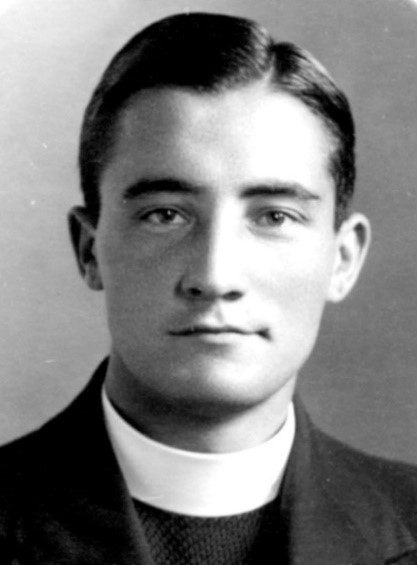
The Story of Fr Jack O’Brien:
Jack O’Brien was born on December 1st 1918 in Donamon, Co Roscommon. His parents were Thomas Joseph and Mary (nee Hegarty) O’Brien

Baptismal Cert

Thomas and Mary had four children:
Jack, who joined the Society of St Columban and was killed at the Massacre at Taejon on Sept 24th 1950
Máirín, who was born on 5th May 1921 in Killala. She joined the Sisters of Charity and her given name was Sr Mary Dolores. She became a teacher and when she retired she studied Hospital Pastoral Care and worked in St Vincent’s Private Hospital. She died on 2nd of March 2000.
Vincent, who was born in Killala Co Mayo in 1923. Vincent also joined the Columbans and was ordained in 1947. He went to the Philippines in 1948. Appointed to Ireland in 1969 he worked in the Archdiocese of Tuam until his death in 1984.
Joe, who died of meningitis as a young boy.
Their father, Thomas O’Brien, was a Station Master in Donamon where Jack was born but moved as was required by his job.
1924 - 1925 Jack attended Kilalla N.S
1925 - 1931 Jack attended Ballinrobe N.S. where he was confirmed on April 23rd 1930

1931 – 1936 Jack attended St Nathy’s College, Ballaghdereen, Co Roscommon.
1936 : Jack went to Dalgan.
1942 : Father Jack O’Brien was ordained on December 21st 1942 in Dalgan Park, Navan

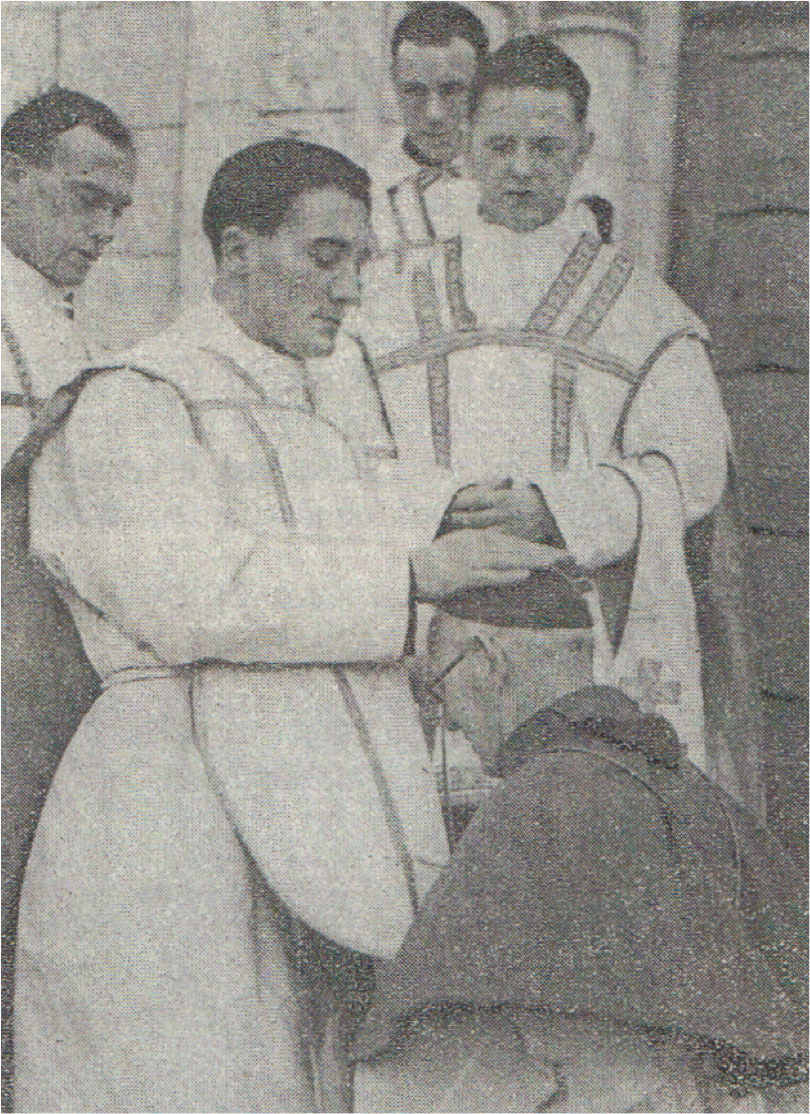
On his Ordination Day, December 21st 1942, Father John O’Brien gives his blessing to the ordaining prelate, His Grace, the Most Rev. Dr D’Alton Archbishop of Armagh, at that time coadjutor Bishop of Meath.
From Fighting Padre to Korean Martyr: Fr Jack O’Brien(1918 – 1950)- Mairéad O’Brien
D-Day, June 6th, 1944, marked the largest amphibious invasion in history, with approximately 156,000 American, Canadian, British and other Allied troops participating in a combined land, sea and air assault on five beaches in Normandy, France. The objective was to gain a foothold across the French coast to liberate northwest Europe from Nazi control and bring an end to World War II. The 80th anniversary of these events was an occasion to reflect and honour those involved. On Friday, June 7th, 2024, Archbishop Eamon Martin, speaking at a prayer service in Ranville, Normandy, paid tribute to Army Chaplain Fr. Jack O’Brien SSC.
John Patrick, or Jack, as he was known, was born on December 1st, 1918, in Donamon, Co Roscommon, the eldest of the four children of station master Thomas Joseph O’Brien and Mary Elizabeth Hegarty.
In 1936, he joined The Society of St Columban, also known as The Maynooth Mission to China and was ordained to the priesthood in December 1942 at the height of World War II. However, due to travel restrictions during the war, he was unable to take up a missionary post in the Far East. Some Columbans, in a similar situation, went to parishes in England to replace priests who had become Army Chaplains, while others became chaplains themselves. Fr. Jack was one of the latter. In October 1943, he applied to become an Army Chaplain or Padre in the British Army. In May 1944, having completed rigorous training at Marlborough Barracks in Wiltshire, he was assigned to the 2nd Battalion of the Royal Ulster Rifles, which was attached to the 9th British Infantry Brigade. This Brigade was a part of the British Third Division, under the command of Major General Bernard Law Montgomery, affectionately known as ‘Monty’.
Within days, Fr. Jack was on board a transport ship at Portsmouth on the south coast of England, waiting to cross the English Channel. D-Day, scheduled for June 5th, was postponed for twenty-four hours when Maureen Flavin Sweeney's weather report from Blacksod Point in Co. Mayo reached the meteorologists in England; the barometer had dropped and stormy weather was imminent. The delay was unwelcome as the troops had already spent several days on board ship in cramped and uncomfortable conditions with little to occupy them while seasickness plagued many of them. For many, it was their first experience of war and the prolonged waiting increased their anxiety. More than a few of them turned to religion for comfort. Fr. Jack spent long hours hearing Confessions, talking and listening to frightened men and generally trying to boost morale.
On the morning of June 6th, hours after an airborne assault, the first of the Allied ships arrived in Normandy. Fr. Jack landed with the 2nd Battalion on the beach codenamed Sword, the easternmost beach of the five landing areas. A heavy swell rose as they struggled to wade ashore, weighed down by heavy uniforms and kit bags, with some carrying folding bicycles. Enemy shells and mortars rained down relentlessly on them.
Once on land, they advanced slowly to the densely forested village of Cambes, which they liberated under intense fire and with heavy casualties. After five more weeks of bloody fighting and an even heavier death toll, they regained control of the strategically located city of Caen. During a lull in the fighting, Fr. Jack conducted a Solemn Requiem Mass for the Catholic dead, while the Presbyterian and Church of England chaplains held memorial services for their fallen men.
No training could have prepared Fr. Jack for the horrors of day-to-day life in war-torn Northern France - deafening artillery fire, the stench of death, blood and guts, decaying bodies, terror in men's eyes, endless burials and the constant state of anxiety. As a non-combatant, he did not carry a gun, and his clerical collar offered no protection against shells and mortar. Despite the deadly challenges, he carried out his duties with courage and infectious positivity. His role was to provide spiritual support, pastoral care and moral guidance. As a chaplain, he provided leadership but did not command. He read and wrote letters and dealt with official documentation for soldiers with poor literacy skills. On the eve of battle, he heard confessions, distributed Communion, and offered blessings and encouragement. He sometimes read aloud passages from the Bible - he found that it comforted the men to know that God was with them. Whenever possible, chaplains of all faiths held Sunday services.
Some chaplains acted as stretcher-bearers and ambulance crew and were often found at dressing stations near the front line, where they delivered basic first aid and administered the Last Rites to those who were dying. Dead bodies, often putrid or mutilated, had to be searched for personal belongings, which were then returned to grieving loved ones back home.
Padres were also a steadying influence on the men and the lower ranks felt at ease with them as they were not part of the administrative structure. Fr Jack liked to join them in their dugouts for a few rounds of poker, often with rum scrounged from the quartermaster. ‘Monty’ valued them highly, “I would soon as think of going into battle without my artillery as without my chaplains.”
His knack for lightening tense situations often diffused them. During a funeral service, a new officer, overwhelmed by the scene, fainted. The Padre caught him as he fell into the open grave, quipping, "Now, there's no need to be in a hurry. All in good time." His Commanding Officer wrote of him: “Another character who must be mentioned was the ‘Fighting Padre’, Father J. O'Brien, who landed with the Battalion on D-Day and saw the campaign to its close. From the earliest days, he made himself peculiarly a part of the Battalion, and his perennial cheerfulness was the salvation of many a drooping spirit in the difficult days which confronted us”.
Having established a bridgehead in Normandy, the Allies launched a series of offensives to advance further eastwards. For the next ten months, Fr. Jack moved with his battalion across Northern Europe, as they liberated towns and villages along the way. They passed through the French towns of Albert, Bapaume, Flesquieres, Moeuvres, Cambrai, and Valenciennes, then moved into the Belgian cities of Mons, Nivelles, and Louvain. They continued through Holland and eventually arrived in Bremen, Germany.
In November 1944 Fr. Jack wrote “My battalion has been in action almost continually since D-Day. They have been through the heaviest fighting in France and also in Holland. Our casualties have been very heavy indeed and I need not tell you that there are very few of the original lot left”.
In April 1945, after the capture of Bremen and the subsequent surrender of Germany, the 2nd Battalion decamped to the German town of Delmenhorst to rest and regroup. Then, onto Mettingen to administer a Displaced Persons Camp, which housed foreign nationals forced into slave labour by the Germans. By August, the battalion was in a village near Ghent, in Belgium, where the persistent rain turned the tented camp into a quagmire. On September 2nd,1945, the war in the Pacific ended, bringing World War II to an end. Amid boisterous celebrations, chaplains of all denominations held ceremonies of thanksgiving.
With travel restrictions still in place, Fr. Jack remained with the Royal Ulster Rifles. In October 1945, he was posted with his battalion to Egypt, where Great Britain maintained a military presence to protect the Suez Canal. By Christmas, he was in Palestine, then under British administration.
In 1948, he was recalled to Ireland to take up a missionary post in Mokpo at the southwestern tip of South Korea. Here he joined American-born Monsignor Patrick Brennan and Clare man Fr. Tommie Cusack. Having survived one war, he could not have expected to be involved in another one, but on Sunday morning, June 25, 1950, the Communist North Korean People's Army launched a blitzkrieg attack on the West-backed Republic of South Korea, triggering the Korean War (1950 - 1953). In a matter of days, they had captured Seoul, the South Korean capital.
American troops, initially on the back foot, were forced to pull out of the Mokpo area, but before they did, they offered the priests safe passage to the port of Pusan, from where they could escape to Japan. Aware of the imminent dangers, the three men chose to stay with their parishioners. The Communists arrived at their door on July 25th, and before long, they were behind bars in the local jail. A week later, they were transferred to the North Korean military stronghold of Kwangju, where they shared a cell with three American soldiers. The soldiers later reported that Fr. Jack had boosted everyone's morale, singing and dancing Irish jigs. A few weeks later, the Columbans, exhausted from starvation, dehydration and lack of sleep, were taken to the city of Taejon.
On September 15th, 1950, United Nations forces under American General Douglas MacArthur, the commander in the Far East and Japan, recaptured Seoul and sent a task force south towards Taejon to block Communist troops from rushing to defend the city. On the night of September 24th, the North Korean army was forced to retreat northwards up the Korean peninsula to avoid being cut off by advancing United Nations troops. Before they left, they carried out a general massacre of prisoners. Monsignor Brennan, Fr. Cusack and Fr. Jack were reported missing on October 18th, and on November 18th, they were confirmed dead. Despite an exhaustive search by Fr. Brian Geraghty, the Superior in Korea, the remains of the three Columbans were never found. Bodies, both dead and alive, had been dumped into deep wells and caves at the time of the massacre.
A memorial to Fr. Jack, the six other Korean Martyrs, and Mother Mary Clare Whitty from Fenloe, Co. Clare, was erected in 2013 in Yongsan-gu, Seoul, by the Embassy of Ireland to Korea, the Irish Association of Korea, the Irish Government, Royal Ulster Rifles Association, Columbans in Ireland and other associations. Fr. Jack is one of the eighty-one modern-day martyrs whom the Korean Catholic Church is promoting for beatification. In 2014 they were declared Servants of God – the title granted to individuals at the first stage of canonisation.
Note: Sincere gratitude to Columban historian Fr Neil Collins SSC and Paul Scanlon, son of Captain MP Scanlon, 2nd Battalion, Royal Ulster Rifles (1943 – 1946).
1949
Father Jack O’Brien arrived in Korea. He worked in Mokpo parish with Father Tommie Cusack and Father Pat Lohan.
1950
On the 25th of June 1950 the Korean War broke out when the North Korean Army crossed the 38th Parallel into South Korea. Those in the extreme south of South Korea had no great fears. They believed that within a few weeks the conflict would end, especially since United States troops were getting into it.
However, on the 17th of July the U.S. Command sent a young man named McDonnell to inform the Columban Fathers that they could no longer defend the Kwangju area and they offered the priests safe passage to Pusan in American convoys and transferred some to an American Minesweeper.
Many priests escaped the advancing tidal wave of Communist soldiers. However, Monsignor Brennan the Prefect of Kwangju, Father Tommie Cusack, Parish Priest of Mokpo and Father Jack O’Brien who had only been in Korea for a few months, took the unanimous decision to remain with their parishioners.
Jack O’Brien, of his own free will did not hesitate to remain in the Battlefield he had chosen and to die for his beliefs and ideals.
In 1956, in his book “One Front Across the World”, Douglas Hyde wrote, “The blood of Christians is a seed.” How true Tertullian’s words prove in Korea today. I think of my friend Fr Jack O’Brien, martyred at Taejon, and other Irish priests mentioned in this book, and hosts of faithful Christian Koreans, and I praise God for the harvest their death has brought forth.
Speaking at an ecumenical service in Ranville, Normandy on June 7th, Archbishop Eamonn Martin spoke of Father Jack’s Christian mission and bravery whilst serving with the Allies in World War 11. Thanks to Paul Scanlon who sent the video.
“I have brought with me today a photograph of Father John Patrick O’Brien SSC, a treasured possession of his relatives back in Ireland. Father John was born in Donamon, Co Roscommon at the end of 1918, just a few weeks after the guns of the so called “Great War” fell silent.”
Archbishop Martin said. “At the age of 17, Jack – as he was known to family and friends – left Saint Nathy’s College in Ballaghadereen with a strong sense that God was calling him to be a missionary priest in the Far East.”
Archbishop Martin had no doubt that Jack O’Brien would have been inspired as a young person by stories of fellow Irishmen, Father Willie Doyle. Father Doyle was a Chaplain in the First World War who was killed by a German shell while running out to rescue two wounded soldiers in No Man’s Land in 1917.
“Many stories were told of Father Doyle’s bravery and deep faith and how everybody in his battalion held him in great respect – Catholics and Protestants alike,” the Archbishop of Armagh said.
“For the newly ordained Father Jack O’Brien, the battlefields of Normandy and beyond were to become his first parish, his mission: “to give and not to count the cost.”, to serve God by keeping hope and human dignity alive amidst the horror and brutality of war.
“As a Catholic chaplain he offered the consolation of prayer and the sacraments to everyone who asked – especially Confession, the Eucharist and the Last Rights – he never forgot a word of compassion and encouragement for the wounded, the worried and the war weary.
The troops called him “The Fighting Padre” because Jack had been a boxer in his student days and several anecdotes are recorded of his positive attitude and good humour. They say he sometimes visited the men in their dugouts for a few hands of poker, often with rum scrounged from the quartermaster and once when a newly arrived officer fainted and almost fell into an open grave during a burial, Father Jack grabbed him saying, “Now there’s no need to be in a hurry. All in good time.”
Archbishop Martin said that it had been largely forgotten “perhaps conveniently at times” that tens of thousands of men and women from all over the island of Ireland served side by side during the Second World War.
Unlike many others, they were volunteers, rather than conscripts – personally motivated to serve the cause of peace and freedom and justice. Within six to ten months of D-day, the RUR Battalion had helped to liberate village after village across Northern France, Belgium and Holland, at last reaching Bremen in Germany.
At that stage Father Jack wrote home saying that sadly not many of his original flock were left, but according to his commanding officer: “(Jack’s) perennial cheerfulness was the salvation of many a drooping spirit in the difficult days which confronted us.”
“After the German surrender, Father O’Brien’s kindly and cheerful presence continued to be a source of great comfort to the displaced and traumatised people they met along the way. Ever the missionary, he travelled on to Egypt where the Battalion was helping to guard the Suez Canal, and by 1946 he was with them in Palestine a long way from the beaches here where he had first landed.”
In 1948 Fr Jack was assigned as a missionary priest in Mokpo on the southern coast of South Korea.
“Father Jack O’Brien’s story of courage continued well beyond D-Day. In 1950 when the Communist forces began to invade South Korea and were approaching his parish, he refused a offer from American troops to be evacuated to safety, preferring instead to remain with his people and serve them to the end,” Archbishop Martin said.
“He was captured and imprisoned, and after a long march at gunpoint towards North Korea, he was executed in the Massacre at Taejon, a month before his 32nd birthday. His body was never found or identified – he was martyred for his faith and belief that neither death nor life can ever separate us from the love of God.”
As his address came to a close, the Archbishop added that coincidentally, Fr Jack’s old comrades, the soldiers of the Royal Ulster Rifles 1st Division, suffered many losses in the Korean War.
“In 2013 a memorial stone was erected in Seoul to record and honour their contribution. Fittingly it records the name of their former chaplain, one Father John Patrick (Jack) O’Brien who had served and prayed with them on those roads and fields of Normandy, 80 years ago today.”
In his reflections Archbishop Martin expressed his gratitude to Father Niall Collins SSc and to Mairead O’Brien for sharing with him the fruits of their research into the life of Father Jack O’Brien.
We, here in the West of Ireland, especially in Ballaghadereen have close ties with the Philippines and with the Columban Fathers in Dalgan. A former Archbishop of Manila was Dr Doherty, a native of Charlestown, educated at St Nathy’s and consecrated bishop with his cousin, Patrick Morrisroe, in the Cathedral on September 3rd 1911. Dr Morrisroe was Bishop of Achonry from 1911 to 1946. He is buried in the Cathedral.
The Maynooth Mission to China was founded in 1918. Since then 23 members have suffered martyrdom. One of these priests was Fr. Jack O’Brien whose father was station master in Ballaghdereen. Fr Jack, his brother Vincent and Joe were educated in St Nathy’s. Jack was born in Dunamon, Co Roscommon and Vincent was born in Killala, Co Mayo in 1923.
Their sister Maureen, would have attended the Convent School, run by the Irish sisters of Charity, an Order that came to Ballaghadereen with little more than an invitation from the then Bishop, Dr Patrick Durkin, but with a burning ambition to educate every child in the parish and indeed far beyond. The amount of work these ladies did between their arrival in Ballaghadereen in the 1870’s to the turn of the century and after, was just miraculous. In her excellent book, “The Ancient Territory of Sliabh Lugha”, Máire McDonnell-Garvey gives a detailed account of those early years in the town. To say the least, they were tough, hard times. Her book should be in every home, school and library. It is a wonderful reference book, the result of years of research and dedication.
Maureen O’Brien joined the order possibly as a result of the example set by her teachers. Sr. Mary Martin and Sr. Joseph. Sadly, like Maureen, all gone to their eternal reward.
Jack went to Maynooth Mission to China, as the order was known in Dalgan in 1936 and was joined in 1941 by his brother Vincent. Fr. Jack was ordained a priest in 1942 and Fr. Vincent in 1947.
Because of World War 11, no priests were allowed into China or indeed to any other area in the Eastern Region. So, Fr. Jack served as a chaplain in the British Army until 1948. He served with his colleagues, Monsignor Pat Brennan and Fr. Tom Cusack, in Mokpo in the south of South Korea.
Sometime later the North Korean Army captured the town. The three clerics were arrested and taken approximately 200 miles north to Taejon. There, it is presumed, they died in the general massacre of prisoners of war and civilians on September 24th 1950. Their remains were never found.
Fr. Vincent went to the Philippines in 1948. He was pastor of Subic in Zambales and had served in Siland, Cavite and San Antonio, Iba. He returned to Ireland in 1969 and was appointed to the Tuam Archdioceses. He died in St Vincent’s Hospital, Dublin, in 1984.
Both Fr. Jack and Fr. Vincent were held in very high regard by all the Columban Fathers. In my telephone conversations with Fr. Cornelius Campion and his colleagues in Dalgan, it came across so clear, of their pride and love for our two Nathy’s boys.
To give your life for your faith surely gives them a “first class ticket” straight to Heaven. Pray for them and their colleagues, yes of course, but also pray to them.
G.F.
(with many thanks to the wonderful priests in Dalgan for their help.)
Gerry Frayne died in May 2002. May his soul full of kindness Rest in Peace.
Courtesy of Echoes.
Father Jack O’Brien was 31 years old when he was killed.
Please click here to read about the Captivity and Deaths of Monsignor Pat Brennan, Fr Tommie Cusack, and Fr Jack O’Brien.