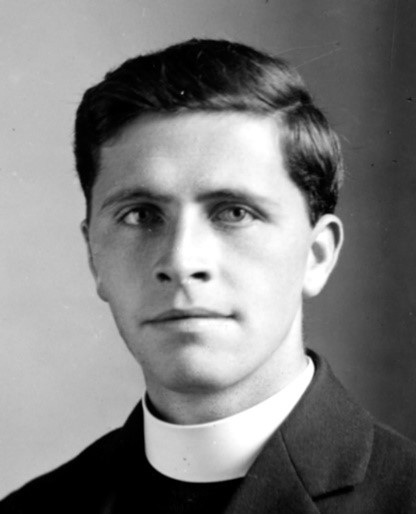
Jim Maginn was the second of four sons of James and Annie Maginn, who owned the Montana Hotel on Main Street, Newcastle, Co Down (where Neesons now stands). He was born in Granite Street, Butte, Montana on November 15th 1911, but his family came home to Newcastle in 1920.
He was educated in St Mary’s Primary School and St Malachy’s College, Belfast. He went to Dalgan in 1929 and was ordained on December 21st 1935.
Father Jim was assigned to Korea in 1936 and ministered in the Shunsen (now called Chunchon) Prefecture .
During World War 11 Father Maginn was arrested together with twenty three other Columban Missionaries in Korea.
He spent a fortnight in gaol in December 1941, followed by three months imprisonment and was under house arrest for the remaining period of the war in his own mission residence.
His one and only visit home was in 1946. His mother had died three years before.
When the war broke out Father Maginn’s hundred parishioners pleaded with him to flee but, as many of them later testified, he refused saying, “As pastor I am staying here in the church”. He divided up all the money he had and gave it to the people who were fleeing.
FATHER MAGINN’S ARREST AND DEATH
Father James Maginn, who has been missing in Korea since June 1950, is now known to have been killed on the 4th of July of that year.
Father Maginn was pastor of Samchok, on the east coast of Korea, some 50 miles south of the political boundary between North and South Korea, the 38th Parallel. He was in his parish when the North Korean Communist forces invaded the territory in June 1950, but when the Reds were driven back in the autumn of that year and our priests were able to return to the district, there was no trace of him and no information of what happened to him.
Quite recently, however, Father Brian Geraghty, Maynooth Mission Superior in Korea, received information from a Korean which told of Father Maginn’s death and the location of his grave.
In the week between the outbreak of the war and the occupation of his parish, he had been urged by his people to leave the town before the Communists came. He advised them to go and some did. Father Jim gave them money to help them survive, but he chose to stay, saying, “I shall remain here and defend the Church until death. I shall bear witness to God to the Communists who deny Jesus Christ.”
A teacher in the High School, John Kim Soo Sung, was very devoted to Father Jim, who had baptised him earlier, and he declared that he could not leave, knowing that Father Jim was willing to face death at the hands of the Communists, so he also vowed to stay.
It is known that Father Jim offered Mass on the morning of July 2nd, the day in which the Reds invaded the village. Two days later, informed on by the local Communists, they came to arrest the priest. As John Kim recalled, “Father Jim received them with calmness and composure.” Entering the church, he knelt before the altar for a short final prayer. The impatient soldiers shouted to him from outside the church. When he emerged, they seized and kicked him, struck him with their rifle butts and were about to handcuff him. With a calm smile, he said, “Make yourselves at ease, I’m not escaping. Let’s go this way.” Overcome by his self-possession, they yielded to his request. He was escorted to the station at gunpoint. A few hours later, John Kim was arrested and detained in an adjacent cell. They questioned Father Jim for two days. Because he had been born in America, they wanted him to confess that he was an American spy.
John Kim got out of gaol when the Reds pulled back in October and he was able to give a detailed account of Father Jim’s last days.
After a period of detention, starvation and torture Father Jim was lying almost unconscious on the floor at midnight when a warder came and shouted at him to get up and come out of his cell. Father Jim had already guessed the reason. He asked them to let him say a word of farewell to John Kim who was still in the adjacent cell. The warders could not refuse the last request of a man about to die. Passing his fingers through John Kim’s hair, he gave him his final blessing, saying, “John, I hope to see you in Paradise. Whatever pain you have to suffer, bear it patiently and never lose your faith in Our Lord Jesus Christ.” He disappeared into the pitch-black night and John Kim’s mourning wails followed him and continued long after he had gone. Father Maginn was hustled barefooted along the rugged mountain road as far as Cha-chi-ri. A shot echoed through the ravine and he fell. Next morning the corpse was found by villagers who charitably buried it at the very spot.
FAR EAST JUNE 1952
It was not until March 1952 after the liberation of Chunchon city that his grave and body were located by Fr Brian Geraghty, on the information of eye-witnesses of his last hours. His body was exhumed and laid to rest on 26th March 1952 beside Fathers Collier and Reilly in the church-yard of Jungnim- dong, now the Cathedral Church of Chunchon Diocese in South Korea.


THE LAST DAYS OF FATHER JAMES MAGINN.
Reverend Father James Maginn (Jin Shin Bu) had been appointed as Pastor of Sam Cheok, and proceeded to his post in 1949. It was one year prior to the breakout of the Korean War, which began on June 25th 1950.
Nowadays a mere child knows what the “Catholic Church” means, but at that time, almost all of the inhabitants of Sam Cheok, had never even heard of the term “Catholic”. They accordingly had no idea what the so-called “Shinboo” of the Catholics meant. (It means “Spiritual Father”.) As Father went there as an unexpected alien who lived in a common-style house, they simply thought that a westerner, with his “frizzled hair and blue eyes” had bought a villa by the seaside, and meant to dwell there in the good air, amid the sparkling streams from the hills.
In those days, as today, many poor people who were not very well schooled, were leading a simple peasant life in Nam-Yang-Ri, around the Catholic Church. They talked in an undertone every time they caught a glimpse of the foreigner. As the first Westerner they had ever met, he quickly became an object of interest to them. He had gone to preach the Gospel of Christ to this sort of people. It was not easy to evangelise this remote village of a strange land, where he spoke the native language and had scant knowledge of Korean national characteristics and local customs.
He began his missionary work here by himself, without family, relatives or friends. He always trusted the residents, many of whom still remained curious about him, and he showed kindness in every dealing with them. He lived up to the teaching of Christ, “Love others, as you love yourself”. He gave food to the hungry, and even shared his own clothes with those who could afford little better than rags. He made fast friends with the students and the children. Soon the people looked on him as they might their father.
It can be recalled that he heated water, and washed children who were poorly cared for. There were backs of hands and feet that often needed scrubbing ! The following happened once:- Father Maginn had an apple tree in his garden. One day when some thievish children were running away with some of his apples, Father Maginn, who was coming out of the Church after having said Mass, caught sight of them. Bidding them come to his room with the apples, he reasoned with them to make them understand their fault, pointing out to them that stealing is a sin, and that sin is bad, and must be avoided. He told them to leave the stolen apples there and sent them away with better apples he had picked for himself.
It has been said, that at that time, Korean children were notorious for theft. Some of them used to call at his house occasionally, and take advantage of his absence to steal a watch from his table or money from his drawer. But he was always kind and consistent in correcting them, and he guided them from their erring ways to the right path, through his charity.
While he was getting along in this way, the tragic Korean War broke out on June 25th . 1950. The Catholics and some interested people who were preparing to take refuge advised him to flee, and go into hiding. But he refused, saying that he had to remain at the Church as long as possible, until the crucial moment, to bear witness to God, in the presence of the Communists, with his Catholic faith, which is opposed to atheism. No matter how pathetically they advised, he stoutly refused to change his mind, so the Catholics had to turn their backs in tears, leaving him behind. He distributed all the money he had in his cash box among the Catholics who were preparing to flee, according to the size of their families, so that they might put the money to good use when they would be in destitution. Of course they would be in dire need of money as refugees.
There was a fervent Catholic youth, Su Seug Kim, who was a high school teacher at that time. He thought that it would not be right to leave Father Maginn alone among Communists. In spite of the priest’s orders to go south, Mr Kim remained with him, making up his mind to share his fate. Within a few days, the Red Army captured the place. As soon as they came, a young so-called “enthusiast” who had been living in Bong Whang Ri informed the reds about Fr Maginn and his where-abouts, and they came swiftly and arrested him.
Father Maginn who was waiting imperturbably, asked for then minutes in which to pray in the Church. He showed no signs of panic. He went before the altar to say a leave-taking prayer to Jesus. He foresaw that this Church which he had spent every effort to establish in the only parish in which he had worked since he came to Korea, would be ravaged by the Communists. And knowing that he was about to begin his “Via dolorosa”, he found it difficult to keep his emotions under control. After all, he was human, he had his feelings too! Covered in perspiration, with his hands still clasped in prayer, the reds kicked him, and thrust him from the Church with their gun-stocks.
When he was coming out from the Church, the soldiers were going to put handcuffs on him, but he said with a smile and in a gentle voice, “I am not a man to escape. If I were such a one I could have escaped already. Don’t be afraid that I will escape! Just let me go as I am, without binding my hands!” The attitude of the priest facing death, walking on before the Communists’ muzzle was very sublime, calm, solemn. So with drooping heads they took him away in silence to Boan-Ser, a Communist police station in North Korea. The teacher Mr Kim was arrested a few hours later, and was confined in the next cell, in the same prison as Father Maginn.
It is easy to imagine to what a degree of torture and suffering they were subjected by the Communists, who were gloating, at that time, over their initial victories in South Korea. Father Maginn was firm in his decision to stand by his faith, even, with God’s grace, to the point of martyrdom. They racked him cruelly and tried to force him to abandon his Catholic Faith, and follow their Communist doctrines, instead of foolishly giving his life for believing in the existence of a non-existent God. In spite of the harsh torture, he bravely testified to the Catholic Faith and to the spirit of anti-Communism to the last.
It was midnight. Father was weak as a result of torture and salvation, after having spent a few days in prison, when the soldiers dragged him out of the cell. They turned their rifles on him , and ordered him to go ahead of them. Sensing what their midnight action meant, Father asked to have a last word with Mr Kim, who was in the next cell. Even the inhuman Communists could not refuse the last request of this man who was facing death so they readily agreed, and took out Mr Kim. Their parting was brief. The priest patted him on the head, and with tears in his eyes, he blessed him for the last time, saying, “John, let us meet in Heaven!” and he walked on.
He was taken barefooted, through the steep mountain pass, in the darkness to Ja-Ji-Ri, and in the dead of night, on the mountainside near the village, he was shot. Nearby villagers found his body the next day.
After the liberation of the country, the place where his remains had been buried was identified by eye-witnesses of his burial. His body now lies at peace by the walls of the Cathedral in Juk- Rim-Dong, Shun Cheon, the Cathedral city of the Diocese of Chun Cheon, Kang Won Do in Korea.
When one thinks of Father James Maginn, one cannot but think of the words of Christ, “Amen, Amen I say to you, unless the grain of wheat falls into the ground, and dies, it remains alone. But if it dies, it brings forth much fruit.”
NOTE. Maria Kim who collected all the above statements is Korean, she is now a Catechist at ST. JOSEPH’S CLINIC, SAN CHEOK.
Dedication of memorial to Fr. James Maginn
5 August 2024 by Guest Contributor
Jang Hyun-min details the blessing - unveiling of a statue and a large mural in memory of Columban Fr. James Maginn who was martyred on 4th July 1950.


Bishop Cho Kyuman speaking at the ceremony blessing the martyrdom site of Fr. James Maginn

On July 4th, the Diocese of Wonju held a ceremony blessing the martyrdom site and unveiling a statue of ‘Servant of God’ Fr. James Maginn (1911-1950) of the Missionary Society of St. Columban, who was martyred while guarding the church during the Korean War. The event took place at 140-2, Jangsan-dong, Samcheok-si, Gangwon-do, and was presided over by Bishop Cho Kyu-man of Wonju Diocese.
Fr. James Jin, whose beatification is being promoted by the Korean Church, was born in November 1911 in Montana, U.S., and was ordained a Columban priest in December 1935. He arrived in Korea in 1936 as a missionary and in October 1949 was appointed as the first pastor of Samcheok Parish (now Seongnae-dong Parish). Immediately after the outbreak of the Korean War, Father James refused his parishioners’ pleas to flee, stating, “We must stand firm in our faith and protect the church until the end to bear witness to God’s truth before the communists.” He was martyred on July 4th, 1950, by the North Korean army.

Bishop Cho Kyuman blesses the mural
The Seongnae-dong Parish of the Wonju Diocese established a martyrdom site along the riverside in Juseong-dong, Samcheok City, featuring a statue of Fr. James and a 105-meter-long mural depicting his life story on a 740-square-meter area. The martyrdom monument is inscribed with, “Fr. James Maginn, Martyr of the Korean War,” followed by a biography and the words, “The parishioners have erected this statue to honour and emulate the noble life and martyrdom of Fr. James, who laid the foundation stone of the Catholic Church in the Samcheok Region and gave his life as a witness to the Lord during the Korean War, ”
In his homily, Bishop Kyu-man Cho stated, “The blessing of the martyrdom site and the unveiling of the statue are being held on the anniversary of Fr. James’s death. Fr. Maginn demonstrated through his death what a priest should do for God and for others.” He continued, “We often say we think about the suffering of others, but it is difficult to accept and sacrifice that suffering when it comes to us unless we are disciplined in our daily lives. Let us pray more for the beatification of Fr. Maginn.”
Father Jim was 38. He was the 2nd of the seven Columban Priests to die.