The story of the Captivity and Deaths of Monsignor Pat Brennan, Fr Tommie Cusack, and Fr Jack O’Brien
The accounts of so many witnesses vary on matters of detail but the general picture emerges clearly. (The Mantle, Winter 1959)
Father Conneely wrote an article in The Mantle to celebrate what would have been the 25th Anniversary of Fr Tommie Cusack’s ordination. He said: “I set out to speak of Fr. Cusack and found that the story of the last months of his life is inseparably interwoven with the story of others who shared his captivity.”
On the night of 17TH JULY 1950 after dinner, two Columban Fathers , Fathers McGinn and Cleary, who had come down to Mokpo from up near the 38th parallel, challenged “the old Mokpo hands”, Pére Brennan and Father Henry, to a game of bridge.
The bridge game had just begun when the Korean houseboy told Monsignor Brennan, that there was a visitor at the door. Soon Pére (Brennan) returned and said, “Well boys, this is it”.
He introduced the visitor, a dishevelled young man named McDonald, from the US Embassy staff in Taegu, who had driven into Mokpo to tell Monsignor Brennan to get his men out as soon as possible and head for Pusan. The North Koreans had crossed the Kum River. General Walker, now commanding UN ground forces, was pulling back to hold the south-east corner; there would be only delaying action at Taejon, and the south-west, which included Cholla namdo province, would not be defended.
Pére Brennan found it hard to comprehend but there was no room for arguments. He thanked the courier who had made the trip of over two hundred rugged miles to warn them here and at Kwangju and suggested that he have a meal and a few hours’ sleep. He asked Father Harold Henry to go down to the port and look for any kind of boat that would take them to Pusan. With the Mokpo jeep and those of the visitors he could collect the men in the other parishes.
The crowded room was suddenly quiet, and Father Henry asked if he meant that he was not going with them. He said yes, he was going to stay. “It was no big deal, it went with the job. And would they now get moving for an early start.”
Father Cusack, the Mokpo pastor, then said he was going to stay. His assistant, Father O’Brien, said he was, too. The Pére looked at each of them a long, silent moment. He didn’t trust himself to speak just then but raised his hand in a half salute that said it all.
Within an hour or so, Harold Henry came back with the night’s first good news. A Korean gunboat had come into Mokpo for a repair job, and the captain had agreed to take the twelve young priests to Pusan. They should go on board soon, because he would sail when repairs were finished.
The others left in the early morning. The Pére was up to wave them off. His two companions had said their farewells and were asleep. He was subdued and in need of sleep himself, but optimistic still.
“We’ll be seeing you, boys!” he called as the jeeps began to move.
They echoed the promise and prayed in their hearts it would come true.
When they were saying their goodbyes on the evening of the 17th , Father Tommie Cusack entrusted Father Michael O’Connor, who was not long in Korea and who was learning the language, with a message to his mother which Father O’Connor sent from Japan.
It read:
5th Sept ’50
St Columbans,
No 56 Hikawa-Cho,
Shibuya-Ku,
Japan
Dear Mrs Cusack,
I am just arriving in Japan from Korea. I left Mokpo before the Communists came in but Fr Tom, Monsignor Brennan and Fr O’Brien stayed behind with their parishioners. Fr Tom was free to leave with us who were studying the language there but he told me to tell you he would never again be happy if he left his parish when his people needed him most. It breaks his heart to cause you such worry, but he was very happy and I leaving him. He knows that deep down in your heart you are happy with him and proud of him.
I was in Pusan for two weeks after leaving Mokpo but got no word from Fr Tom or the priests in Mokpo but I know Bishop Byrne, an American Bishop in Seoul, is free to drive around the city so we are quite sure that the Irish priests are safe but like the priests in China will not be able to write. But please God the Americans will soon drive the Communists back.
As soon as I get any news I will let you know. There are nine of our priests in Pusan and they might be able to get some news through to us from Fr Tom.
God bless you and strengthen you
M O’Connor.
(A member of Tommie's family has the original handwritten letter.)
24th July 1950:
The Communists entered Kwangju at 11 p.m. on July 24th and were in Mokpo within 3 hours. A truck load of soldiers pulled up at the front door, and when Dominic, the houseboy, told Monsignor Brennan that the Reds had arrived, Monsignor knelt down and began to say the rosary. When the Communists were told that this was a Church, they said they were not opposed to anyone’s religion and went away.
(The Mantle, The Splendid Cause Chapter Four, Apostolic Prefecture of Kwangju. Summary of Events)
25th July 1950:
The next morning the Communists returned to Mokpo and when Father O’Brien was going up to the Church to consume the Blessed Sacrament, he was not allowed to go but later Father Cusack was. When he consumed the Blessed Sacrament, he was marched around the whole town. So too was Father O’Brien. Father Cusack returned first and was told by the Reds that there was religious freedom. This was a ruse to put the Catholics at ease so that later they could find out easily who the Catholics were. The three were then brought to one police box and returned here and then brought to another police box and returned home and told to carry on.
One of the boys in the house was beaten and Monsignor apologised to him for it.
30th July 1950:
Mass was as usual on the following Sunday. After Mass some Communists arrived and asked Fr Cusack for a list of his parishioners. He refused to give it. Pressed, and threatened, he continued to refuse. Mgr. Brennan was next approached, and he too refused. “
4th August 1950:
On Friday, August 4 – the three priests were arrested and lodged in the local station. About a week later they were transferred, under guard, to Kwangju.
Kwangju, the provincial capital, is fifty-three miles distant from Mokpo. The prisoners were accompanied by two armed guards. Transport for the five consisted of one motorcycle with a sidecar. The priests were big-boned heavily built men. Presumably it was a ride to remember.
In Kwangju Fr Lucius Chang, himself a prisoner, was summoned to interpret for them before the chief of the secret police. He recalls how they looked: Father O’Brien “thin”; all three of them “terribly tired.” Fr Cusack, fluent in Korean, was spokesman; “he did all the talking and I really don’t know why I was there at all,” comments Fr Chang. The dreary, pointless interview dragged on in the manner of such Communist Interrogations. The priests were accused of spying; of living as drones off their parishioners. Had they been military personnel, they would have been killed immediately and without mercy. Now, however, they were in protective custody, to save them from the fury of the people. While the war lasted they must content themselves with ordinary prison fare; after that they would eat well, as they, and all the Communists, normally ate.
At some point in the interrogation Fr Cusack begged that they should be allowed some rest: “We haven’t slept for nights.” When the examination ended, they were lodged in a cell in the police station and Fr Chang was confined in the town prison. He never met them again.
The following is the next piece of information that we have.
Excerpts from an article in Argosy Magazine Mar. 1951 PP61-62
Fr Donal O’Keeffe gave me this document. He explained that it is “a less sanitised version of “I Met Them in Jail” written by Lieutenant Alexander G. Makarounis 438 Fletcher Street, Lowell, Mass., an American army officer who was taken prisoner by the North Korean Army in August, 1950.
In Kwangju Jail Lieutenant Alexander G. Makarounis met three Maynooth Missionaries, Mgr. Brennan, Father Cusack and Father O'Brien. These Missionaries are presumed to have been killed later in Taejon. Lieutenant Makarounis died on the 31st July, 1994. He also repeated this as part of his testimony at the hearings about The Korean War Atrocities.
This is his story:
War and Capture:
I was with an infantry group that shipped from Okinawa in July of last year and landed in Korea in the early days of the” police action” there. Almost immediately after our arrival we contacted the enemy. Outnumbered, pinned down in a rice paddy by mortar and machine-gun fire, our battalion suffered serious reverses. Many were killed; many were wounded; many survivors were made prisoners.
In this action I was wounded by machine-gun fire and taken prisoner. However, some time after our capture, three of us, Corporal Wilson from Detroit, Pfc Shaffron from Pennyslyvania and myself managed to escape during an air raid. We wandered aimlessly for days and then, on the verge of collapse, we again fell into the hands of the enemy. It was early in August, 1950.
After about three harrowing weeks during which I seesawed between here and the hereafter, we were held in the city of Kwangyang, where the soldiers with me were badly treated and deprived of their shoes. Our food during these days was nothing more than a ball of rice early in the morning and another after sunset. Then the three of us were taken south to the town of Kwangju. This is a good-sized city by Korean standards but only the main streets are paved; the houses are small and there are no stores such as we know them.
Kwangju Jail:
We were taken to the jail – a large sprawling low building, set back from the road, with a large courtyard in front.
When we got into the prison, we were at the end of a long line of Koreans, and they started to pile them into cells that were already full. I believe there were at least ten cells down this one long corridor. Sometimes there would be as many as 75 men in each cell, and it was so crowded that everybody had to sit with his knees up to his chest continuously. They started to shove us into one such cell, and then, for no reason that we could see, changed their minds. And that was a lucky break for us.
Instead, they took us down another corridor and then made us take off our shoes and belts (they almost always made us do that) and put us into a dark cell that seemed to be deserted. The iron door creaked shut behind us and the lock snapped tight.
I was half asleep at the time, but I wasn’t too surprised when I heard this American voice say,” Don’t worry about it Mac. You just get some sleep tonight.”
We did, and I myself can say that I felt very good, hearing that American voice, which sounded kind and sort of home-like. You might put it down that I had dreams instead of nightmares that night. I might add this right here too: Even though whoever belonged to the voice couldn’t see me, he shared his blanket with me, and whoever else was in the cell did the same for Wilson and Shaffron.
The next morning it was wonderful; I turned over and opened my eyes, and there looking at me and kind of smiling were these three Roman Catholic priests. I’ll put their names here, though I didn’t find them out until later. One was an American Monsignor Brennan, and there was a Father Kusak and a Father O’Brien, both from Ireland and with these terrific Irish brogues. Father Brennan had one too, though to a lesser extent.
Father Kusak had spent 15 years in Korea, and he could read and write and speak the language. Father Brennan and Father O’Brien could say a few words each, not many. All three of them were missionaries and had been arrested about a week after the war started. They all three expected to be shot, but it didn’t seem to bother them. If it did, they didn’t let on.
I mean by that Father Brennan was always cheering us up. Once we heard a bird chirping outside the window, and he said, “That’s a good sign lad. That’s an omen of hope.” He said exactly that; I remember the words. Or Father O’Brien would sing songs, mostly Irish songs, and once he danced a jig, and one other time I will not likely forget he sang, “Far Away Places”, and we cried like babies, all six of us.
The food was quite good at Kwangju; we had half a bowl of cooked barley three times a day, and it tasted better than the rice, and also we were given pickled turnips, which were delicious, something like our dill pickles. We were in this cell two days and two nights, and once a doctor came in, and with him was a nurse. By this time my right side was practically just the bone with some of the skin rubbed off even, and my right hip was almost all bone too, every time I moved, my bones creaked something awful. I couldn’t sleep on my stomach or, for some reason, my left side either; so I had Father Kusak ask the doctor if I could sleep on my back, and he took a long look at my wounds and then said yes. And that night, our second in Kwangju, I slept better than I ever had before.
The second afternoon in Kwangju they took Wilson, Shaffron and me through a courtyard, then about 500 yards down the street and into a church which was pretty much like an American church, only poor, very poor. Inside this church were desks lined up against the wall, maybe 20 of them, and behind each desk was a Korean, an interviewer. They put me on a chair beside one desk with this captain. They took Wilson and Shaffron back out into the courtyard and shoved them inside a little house there.
This captain was a young man, as much as you can tell the age of a Korean, maybe in his twenties or thirties, but as he had a hard face, and he was mad clear through, because it took at least an hour to find an interpreter. They finally dug up this character who said he was a photographer, and he spoke fairly fair English.
All through the questioning the captain kept getting mad every once in a while. He’d say things against MacArthur and against Truman, and he’d say (and the translator would translate) and it was all Wall Street’s fault that there was this war. And he wanted to know about my family, too. He kept saying what did my old man do, and I said that he was retired but that he’d been a worker in the woollen mills in Lowell, and that seemed to please the captain. He also got quite a charge out of the fact that my mother was half Russian and was born over there. And he grinned from ear to ear when he asked did I own any property and I answered no.
After he was through with me he brought in Shaffron and Wilson, separately and they said he gave them the same business.
By the time all this questioning was over, it was dark outside. All of a sudden, a Korean major appeared at the little house we were in there in the yard, and he took us back into the church.
By this time there was blackout curtains on the windows, and the captain had disappeared. In one corner of the room were five scared looking South Korean prisoners, all of them handcuffed. The major said something sharp to them; then he took the handcuffs off the two of them and manacled Shaffron and me together and put Wilson together with one of the South Koreans. Incidentally this Korean soldier later turned out to be a parachutist in what you might call the South Korean Air Force, and he’d been dropped some place there and captured.
Journey to Taejon
When we were all set, the major said in a broken kind of English, “We will go to Seoul tonight.” Just like that. Then he herded us onto what was probably the same truck we’d come on; it was standing there outside the church.
First off, they drove us up in front of the jail, and in a few minutes all three of our faces broke into grins, because out of the door came the three priests, one after the other. And behind them to our surprise, were two G. I’s we’d never seen before.
I think it was Father Brennan that had said there were these two G.I’s that had been in the prison, but he thought they’d gone. One was named Miller, and I never did get the other boy’s name. They had started to march to Seoul from Hadong and got sick on the way; got the GI’s I believe. In case anybody’s forgotten, the GI’s is just an army name for dysentery. I might add that Miller was barefoot, and the other boy had some kind of stockings on but no shoes.
Generally, at this time, we were happy; we really were. It was crowded on this truck: maybe 32 of us altogether – us three, Miller and the other boy, the three priests, the five Koreans from the church, and lots of other South Korean prisoners that had been brought from the prison. Also, what with the branches of trees to camouflage the truck, you sometimes had a little trouble getting your breath.
But, like I said, we were quite happy. I mean by that, we had been told there were lots of American prisoners in Seoul and also there was good food and the Red Cross, and we figured we could write letters and get letters and that our folks would find out we were alright. So generally, we were encouraged. I hope nobody will take offence if I say here that most of these Koreans, I met reminded me of lawyers. You know, you ask a lawyer a question, and he’ll give you all the points for and all the points against, but you’ll never get anything definite out of him. The North Koreans were just like that, except when you did get a definite answer, it was almost always a lie. I don’t mean that’s necessarily true of lawyers of course. I mention that because there wasn’t any Red Cross in Seoul or anything like it.
Anyway, we started off, and I remember two things especially. First, these handcuffs were the kind that get tighter as you struggle. Well with the fast driving and going over these bad mountain roads, we jerked all the time – you couldn’t help it – and the cuffs would tighten. It was very painful. Also, about the guards on the truck. We judged them to be front-line troops who were maybe being given a break, and they hated us. You could tell that right away. As we rode along, they would point their guns at the hills and shoot – and then laugh and sing, and if we moved an inch (not that we could move much more than that) they’d jab their guns in our ribs and start to click the bolts, and then laugh again. I figured this was just more of the good old Korean sense of humour.
We were on the truck for three nights, three nights straight. We’d drive all night, and every morning we’d be thrown into a jail cell and given a rice ball. Then at dusk off we’d go again. It was cold too. Even though our bodies were huddled close together, we always seemed to be shivering and our teeth chattered.
Early in the morning of the third night, before dawn, the truck broke down. I never will know what was wrong with it; I think it just gave up. At that time Father Kusak said we were about seven miles outside the town of Taejon. And quite a loud argument developed among the guards – as to whether we should be marched into Taejon or let stay in a group of buildings just off the road from there.
The ones in favour of our walking won; they always did. So off we went, Miller with his bare feet started to bleed almost at once. The other boy’s stockings wore away after only half a mile or so, and the Korean prisoners who were ahead of us started to walk double-time – or faster.
We had to keep up; a rifle but jabbed in our ribs convinced us of that. I hobbled along as best I could for a while, and then my chest started to heave, and the first thing I knew I was practically out. Father Brennan, who was beside me, was having an even worse time. The Father was in his forties. I’d say not young; and also, he was a stout man. He said he’d lost 50 pounds or so since his capture, but he still weighed a good 150.
He was puffing away, but he was thinking more about me than himself. He kept saying, “fall down lad. They won’t shoot you.” But Father Kusak , who was right behind us said, “For God’s sake, don’t do that. These guards say they’ll shoot anybody that falls out.”
So I kept on, I don’t know how I did it, but I did. Then we came close to this long bridge, maybe a mile outside the city – we could see the buildings from where we were – and the pace got even faster. I didn’t know why, but I found out almost immediately. A bunch of airplanes – light bombers, I think – started roaring overhead, and we all ducked under the bridge. I just fell to the ground, and for a minute there I blacked out. Maybe Father Brennan did too, because he slipped on the rocks leading down to the water. He had slipped as much as eight or ten feet when Father O’Brien reached over and grabbed his hand and pulled him back.
The planes didn’t bother the bridge, and a few minutes later the guards made us get up again, and we started off at an even faster pace. This time I knew I wouldn’t make it, and I was sure I’d be shot; and I just gave up when a guard came up to Father Brennan and me and hit us on the arm with his sub-machine gun and motioned us to fall out of the column. I could see Father Brennan’s lips moving, and I knew he was praying, and I guess I did too, and I looked back at Wilson and Shaffron and Father O’Brien and Father Kusak.
I think I said, “Goodbye.” Something like that. I knew it was the end, but it wasn’t. This guard indicated to us that we could walk slow. Well, I never thought anything like this could happen to us and I guess I cried a little. The rest of the column went ahead, and Father Brennan and I continued at a nice slow pace. When we got into Taejon, our guard who seemed sorry for us in some way, took us into a big stone building, and there were the rest of the prisoners.
I went to sleep right on the floor, and about an hour later a civilian came in and woke up us five GI’s.
We didn’t say goodbye to the priests – there were never any goodbyes – and we never saw them again either. I think about them sometimes even now, and I hope they weren’t shot. I hope maybe Father Brennan was right.
He kept saying. “Everything will come out alright in the end if you trust in God.” Maybe that sounds kind of corny, you know, but it sounded fine at the time. And I kept remembering those words all the time later…
The five GIs left and any information that we have on what happened in Taejon after that came from different sources.
Fr Donal O’Keeffe told us that the “valuable prisoners” were billeted in the Franciscan Monastery in Taejon. The North Korean Forces made this monastery their temporary headquarters and each time there was an air raid by UN forces, the Western prisoners were ordered on to the roof to be used as human shields.
15th September 1950:
The American forces landed in Incheon, laid siege to the city and sent a task force south towards Taejon to block Communist troops from rushing to the defence of the capital. Simultaneously, the American Eighth Army broke through its containing line in the south east and drove north-west to link up. Arrangements were made to dispose of the prisoners held at Taejon. (The Mantle)
24th September 1950:
The wife of a Korean Judge said that she had been confined to the same room as the three Priests from Mokpo in the Franciscan Monastery for forty days. She was released on the afternoon of September 24th and later testified that when they heard a prisoner being interrogated about Catholics in Taejon “the three foreign priests went down on their knees and prayed throughout the night for that prisoner and then their knees were so stiff that they couldn’t get up.”
After the massacre, when the North Koreans had left, she and her friend Teresa went back to look for the priests’ bodies but could not find them.
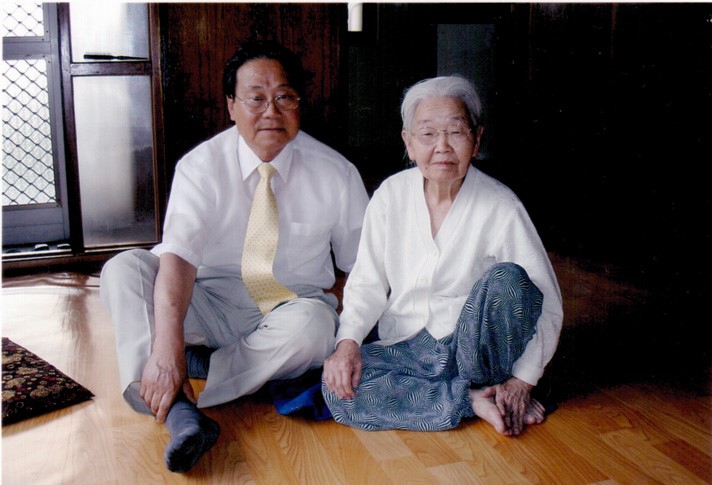
The Judge’s wife who heard the three Priests being interrogated. This lady lived to be 97. She is the most reliable witness they have
On the night of September 24th a General massacre of Prisoners took place in Taejon as Red troops prepared to hurry north so as not to be cut off by advancing United Nations troops Between 5,000 and 6,000 people died. This included prisoners from the Franciscan Monastery and the jail in Taejon. Among them were Father Jack O’Brien, Monsignor Patrick Brennan and Father Tommie Cusack.
We, their families, were always told that the story ended with: “Their bodies were thrown into a disused well and they were never found.”
While this is true, it is not the end of the story. To understand what happened next, please follow the link by clicking here..
- Details
- Hits: 6123

Tony Collier was born in Clogherhead, Co Louth on June 20th 1913. He was educated in the Christian Brothers School, Drogheda 1921 -1926. He attended St Patrick’s College, Armagh, 1926 – 1931. Tony went to Dalgan in 1931 and was ordained there on December 21st 1938.
He was assigned to Korea in 1939. He had not long finished language studies there when the Japanese attacked Pearl Harbour on December 8th 1941. Together with the other Columban Fathers he was placed under house arrest until 1945.
In 1949 he was appointed as the first Parish Priest in the new parish of Soyangno, Chunchon City.
After Mass on June 25th people talked of fleeing and wanted the priests, Fathers Tom Quinlan, Frank Canavan and Tony Collier to come with them. In Chunchon that afternoon the priests discussed the situation. An American officer offered to take them to safety but they declined. Tom Quinlan later wrote that Father Tony refused saying, “I want to be with my parishioners.”
Killed In Korea
In a letter to our Superior General, Father Brian Geraghty describes the circumstances in which Father Collier met his death.
I cabled you a few days ago that Father Anthony Collier was killed by Communists on June 27. Here is the full story of the circumstances of his death.
As you know, Father Tony was in charge of the second, newly-created parish in Chuncheon city. He had his own little residence, away from Monsignor Quinlan and the other priests, who lived in the central, principal mission residence in Chuncheon.
War Breaks Out
By the evening of Sunday, June 25, I imagine that everybody was aware of the large-scale outbreak of war along the 38th parallel. On Monday June 26th, a U.S. officer asked Mgr Quinlan and the priests to leave Chunchon with him (Fathers Hayward and Burke had gone to Seoul on business the previous afternoon, leaving Mgr Quinlan and Father Canavan in the main parish). Father Collier visited Mgr Quinlan on Monday – both of them realised that the fighting was coming nearer the city – then, late in the afternoon, Father Collier decided to return to his own parish, where he slept that night and offered Mass the following morning.
The Communists Enter Chuncheon
The resistance offered by the Southern army was strong on Sunday and Monday, but in the early hours of Tuesday morning the oncoming Red forces had the situation well in hard and the shell-fire eased off. It seems that Father Collier decided to re-join Mgr Quinlan and Father Canavan and set out for their residence in the early afternoon. He had not gone very far from his church, accompanied by his teacher, when he saw that the Red army had already taken over part of the city at least.
Father Collier Interrogated
A number of Red soldiers were stationed outside the Post Office. On seeing Father Collier one of them rushed forward and asked him who he was. Father Tony replied that he was a Catholic priest, working in Korea solely for the spread of the Catholic faith. Asked next if he was an American he replied no, that he was Irish.
THE WHOLE problem of meeting with such a person and of how he should be treated seems to have been outside the ordinary soldier’s training, so an appeal was made to the officer commanding the men in that particular place. The officer came along, asked the same questions, searched Father Collier’s pockets and removed his watch, rosary beads and money, together with the other personal belongings he had on him at the time. He then warned Father Collier that unless he gave a true account of his work in Korea he would be shot. Father Tony could only make the same answer, that he was a Catholic priest, occupied in Church work only, and that he had no other reason for his presence in the country. His young teacher, to the same questions, replied that his work consisted in helping Father Collier and that he was engaged in no political activities of any kind.
Priest and Teacher Bound
The officer was not satisfied. He ordered that their hands should be tied behind their backs and that they should be tied to each other. Then they were marched towards the river, apparently with the intention of throwing them in. After about ten minutes, however they were halted and again asked to tell the truth about their position in the city and the particular military and political work they had done. They were promised that their lives would be spared even now if they told the truth. They could only answer as before, so they were ordered to turn their backs and move forward. When they had taken a few steps the first shot from a submachine gun hit Father Collier, then the second and he fell and in falling pulled his teacher to the ground with him. The third and fourth shots hit the teacher, the fifth and final shot hit Father Tony again. The officer and soldier debated whether they should fire again but came to the conclusion that both were dead, and they went away.
IF THE FULL story of this Korean War is ever written, it will contain many accounts of men escaping from the very jaws of death. It was common to line those to die along a trench or drain and shoot them into it. The first man in the line had no chance of escape, but some have saved their lives by falling into the pit as the shots were fired and waiting there among the dead. The number who thus escaped at any particular time was in proportion to the number to be executed, but apart from Father Collier’s teacher, I know of no other one escaping when only two victims were concerned.
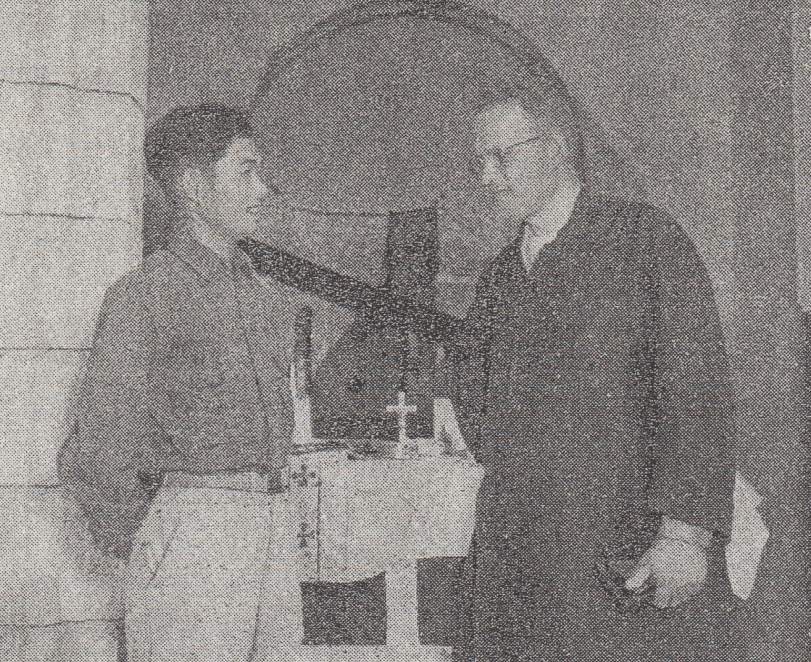
Gabriel Kim Escapes
The boy, Gabriel Kim, was shot through the shoulder and throat, but he tells me that he never lost consciousness, and to him we owe this detailed account of Father Collier’s death. Two or three hours after the shooting the same, or other, Reds covered the bodies with a rice bag and from that time there were no passers-by. Gabriel lay beside the body of the dead priest a day and two nights, working feebly to free his bound hands from those of Father Collier. An empty house was at hand and he made his way there, tied up his own wounds, changed his European shoes for a pair of Korean rubber shoes, got an old coat to put on over his blood stained shirt and made his painful way to the hills. He was helped on his way by one old man who was not too inquisitive about the manner in which he had got his wounds.
ABOUT TEN DAYS later Gabriel got word of Father Collier’s death to his father, the head Catholic of Chuncheon, who had himself been compelled to take to the hills. But there was nothing that the father could do about burial, as the Reds were not driven out until October 3rd.
Father Collier’s Work
Father Collier will be remembered by our own priests and by the people for the care and thoughtfulness he always showed in his work, and for the exactness with which he attended to his church and mission compound. He was to build a church this year, for which he had already been collecting materials and had marked out the site. There, I think, I shall bury him finally. I feel sure that is what he would want: to be with the people of this parish he had started. There is one consolation he may have had in dying: he lived long enough to know that his boy would probably live; even, that in dying he had been instrumental in saving his life. To his mother and all his family the priests here send their deepest sympathy.
Very sincerely yours,
BRIAN GERAGHTY.
THE FAR EAST JANUARY 1951
This account is by Gabriel Kim, who was with Fr. Collier in his final hours and death.
The Martyrdom of Tony Collier - an eyewitness account by Gabriel Kim.
According to the request of Your Excellency, I Gabriel, describe here briefly what I saw and felt during the “martyrdom” of Fr Anthony Collier.
On the 25th of June 1950 we met some refugees after the Sunday Mass and were informed that the roaring of the guns we had heard earlier that morning was that of the invading Red Army. The shells began to strike the streets in the afternoon, but the church was still safe since it was under Mount Bong Ui. We had the Evening Prayers with several Catholics who lived near the church, and though we did not know it, it was to be our last Benediction.
On the 26th after Mass the shells began to strike spots nearer and nearer to the church, and Fr Collier who had said “If anything happens, I must remove the Blessed Sacrament” consumed it. After luncheon, we moved from the kitchen into the shelter in the backyard of Soyang parish Church to escape the danger of bombardment. A shell struck the kitchen soon after we had left it, and nobody was hurt. Father said” It`s just as well I removed the Blessed Sacrament” and he added “It`s dangerous here. You should move on. I will watch the Church”. At that time James, Therese and I were there with Father Anthony. His decision was so firm, that Therese and I left Father, and went home during an interval in the bombardment.
Having told my parents who live Hyo-Ja-Dong that I would go back to Father Anthony, I left for Juk-Rim-Dong Church to see Your Excellency- Bishop Quinlan. After reporting to the news of So-Yang-Tong parish I said Goodbye to Your Excellency, who had been wounded on the face. When I went back to So-yang-Dong parish I told Fr Anthony about Jug-Rim-Dong Church and the down-town situation. He was glad to hear the news, and worried about Your Excellency`s wound.
The shelling continued all night long. On the morning of the 27th, we knew that all the South Korean Army had evacuated the position near our Church and we saw the Red Army advance along the road. At about 1 pm, I recommended Father to go to Juk-Rim-Ding, instead of staying alone at So-yang-Dong Church. To his enquiries about the local Catholics, I replied that everybody had safely escaped from the town.
Having finished the Breviary, he said it might be better to go to Juk-Rim-Dong where Your Excellency was and we left. I can`t help but feel sorry that I recommended him to go to Juk-Rim-Dong as there were other possibilities for his safety.
After we left our Church, we saw nobody on the streets of Chunchon, till we came across two Communist soldiers at the Rotary in the main street of Chunchon. They held us up, stole everything we had and bound our hands together. They asked Father Anthony “who are you”. He replied “I am a Priest”. They asked again, “aren`t you a spy” and he answered calmly , “I am a Catholic Priest, a Missionary”. Then we were taken to the Post Office which was about 100 meters from the place where we had been arrested. There were many Red Army military cars there.
The two soldiers reported to a man, who seemed to be a Commanding Officer, that they had caught two spies. Father Anthony declared again that he was not a spy but a Priest. The officer ordered them to take us somewhere, but where I could not hear clearly. They ordered us to go to the nearest river, and we walked along a road behind the Chunchon High School towards the down-town section. I guess Father Anthony already knew he was on his way to his death. We came across several groups of Red Army soldiers, who mocked us, but Father Anthony walked on calmly. I thought I would soon be in Heaven also, since I was with Father Anthony, who had devoted his life to Our Lord, so I asked him to forgive me for all my faults in the past. He said “yes”. When he started to continue speaking, the soldiers shouted to us to keep quiet. So we walked on in silence.
When we arrived at Kyong-Chun Road they ordered us to go into a lane. We stopped in front of a small empty sloping garden at a distance of about thirty meters from Chun-Chon Revenue Office. The soldiers said to Father ”If you have any family or relations we will send them news, so speak up” Father replied ”I have not” They asked Father “Will you make a will” Father said ”No”.
They proposed covering his eyes, but Father refused and they shot him in the back. I did not know what kind of gun they used as they had three kinds of guns, a rifle, a pistol, and a magazine-rifle. They fired five times and the first, fourth and fifth shots were aimed at Father. It was about two o`clock in the afternoon. Father fell down without any words.
The state of my mind was so serene that I had no dread of death. At the moment of hearing the shots, all my mind was filled with the hope of Heaven, since I thought I would be dying with Father, who had sacrificed his life for Our Lord, and there was no room for any other thought about this world.
Considering that such a worldly person like myself possessed such a state of mind, at that time, I do believe that Father who had spent all his life for Our Lord, had a mind full of love for Our Lord, which made him walk on the way to death with no complaint or refutation, but with a calm attitude and even a smile.
I lost consciousness when the Red Army left the place. When I first regained consciousness, Father was still breathing, and the sun was still high. When I came to my senses again, he had stopped breathing, he was covered with a straw mat, and the sun was setting. There were bullet wounds on Father`s face and arm. I left the place on the morning of June 29th.
I attended as a witness at the exhumation of Father Anthony`s remains by U.N. soldiers on the 9th October 1951. The place was correct, and they were indeed Father Anthony`s clothes. The body had wounds on its face and arm and there were three medals which Father always wore. After prayers for the dead, the remains were removed to Juk-Rim-Dong Cathedral.
The next day October 10th, the Requiem Mass and Final Absolution were held by Fr Tji, at the partly ruined Cathedral, and the funeral took place behind the Cathedral.
I swear that all of the above about Father Anthony Collier is true.
Signed: Gabriel Kim Kyong Ho.
After signing the original document in Korean, Gabriel Kim took an oath that it is all true, in my presence in Chunchon 5th October 1968.
Thomas Quinlan.
Tit Bishop of Boccorica. 13th January 1969.
In the November 2020 edition of the Far East Father Liam O’Keeffe writes:
“The 70th anniversary of the Martyrdom of Fr Anthony Collier (1913 – 1950) was celebrated in a special ceremony in Chunchon on 27th June last. The 70th anniversary of the founding of Soyangro parish, where Fr Tony was the first pastor, was also celebrated. His life is depicted in various tableaux in the parish grounds.
Bishop Luke Kim was chief celebrant of the Mass attended by priests of the deanery and a full capacity congregation. Father Thomas Nam, vice director of the Korean region, and I represented the Columbans. Also present was Susanna, the younger sister of Fr Tony’s catechist Gabriel Kim. She was a teenager at the time of Father Tony’s death.”
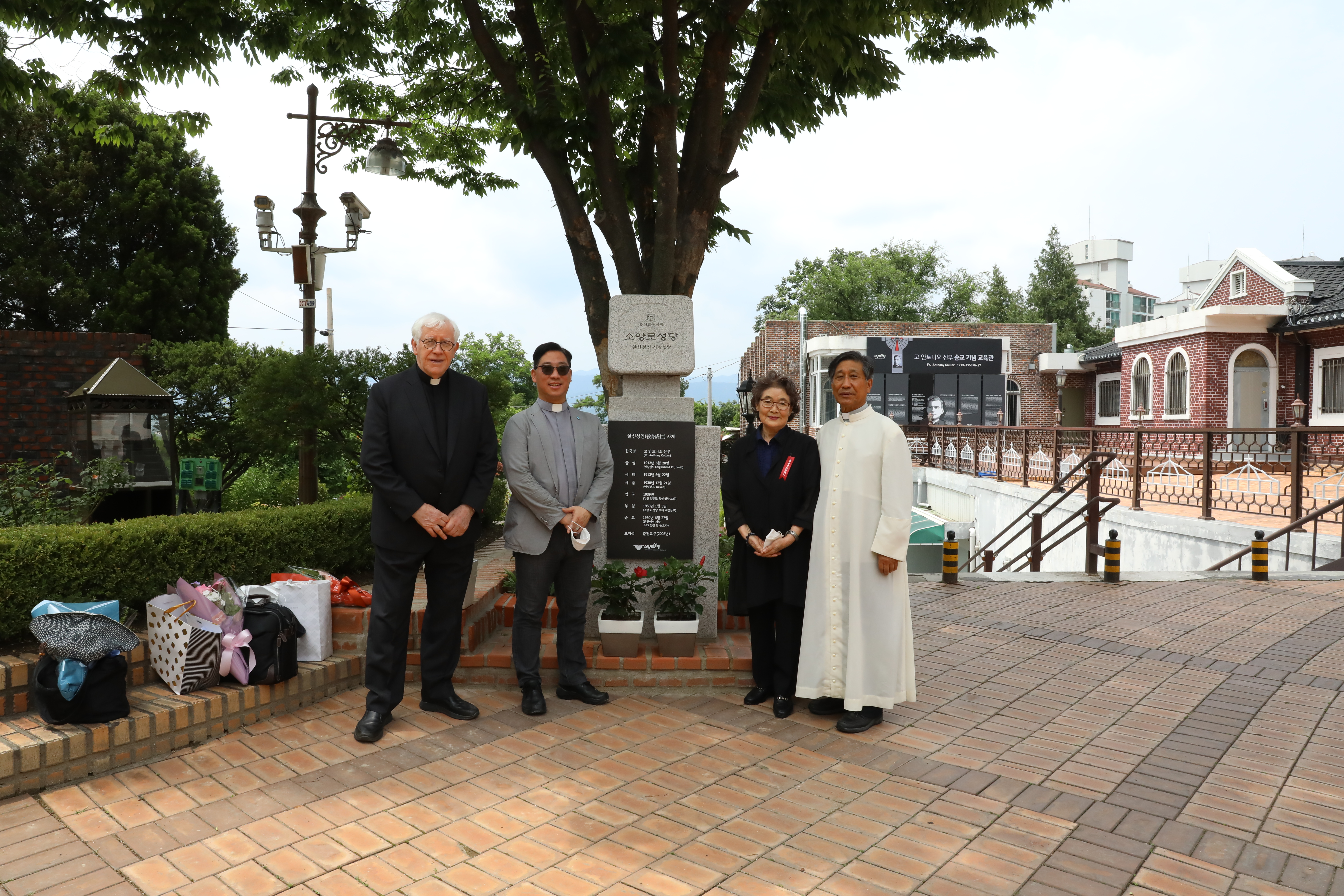
Columban missionaries Fr Liam O’Keeffe and Fr Thomas Nan, Susanna Kim, younger sister of Fr Tony Collier’s catechist Gabriel Kim, and Fr Julio Kim.
Father Tony was 37 years old. He was the first of the seven Columban Fathers to die.
- Details
- Hits: 5121
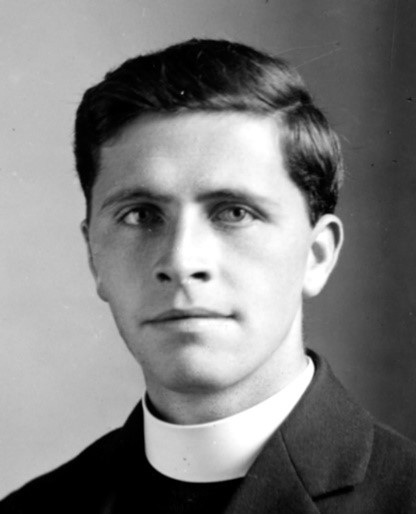
Jim Maginn was the second of four sons of James and Annie Maginn, who owned the Montana Hotel on Main Street, Newcastle, Co Down (where Neesons now stands). He was born in Granite Street, Butte, Montana on November 15th 1911, but his family came home to Newcastle in 1920.
He was educated in St Mary’s Primary School and St Malachy’s College, Belfast. He went to Dalgan in 1929 and was ordained on December 21st 1935.
Father Jim was assigned to Korea in 1936 and ministered in the Shunsen (now called Chunchon) Prefecture .
During World War 11 Father Maginn was arrested together with twenty three other Columban Missionaries in Korea.
He spent a fortnight in gaol in December 1941, followed by three months imprisonment and was under house arrest for the remaining period of the war in his own mission residence.
His one and only visit home was in 1946. His mother had died three years before.
When the war broke out Father Maginn’s hundred parishioners pleaded with him to flee but, as many of them later testified, he refused saying, “As pastor I am staying here in the church”. He divided up all the money he had and gave it to the people who were fleeing.
FATHER MAGINN’S ARREST AND DEATH
Father James Maginn, who has been missing in Korea since June 1950, is now known to have been killed on the 4th of July of that year.
Father Maginn was pastor of Samchok, on the east coast of Korea, some 50 miles south of the political boundary between North and South Korea, the 38th Parallel. He was in his parish when the North Korean Communist forces invaded the territory in June 1950, but when the Reds were driven back in the autumn of that year and our priests were able to return to the district, there was no trace of him and no information of what happened to him.
Quite recently, however, Father Brian Geraghty, Maynooth Mission Superior in Korea, received information from a Korean which told of Father Maginn’s death and the location of his grave.
In the week between the outbreak of the war and the occupation of his parish, he had been urged by his people to leave the town before the Communists came. He advised them to go and some did. Father Jim gave them money to help them survive, but he chose to stay, saying, “I shall remain here and defend the Church until death. I shall bear witness to God to the Communists who deny Jesus Christ.”
A teacher in the High School, John Kim Soo Sung, was very devoted to Father Jim, who had baptised him earlier, and he declared that he could not leave, knowing that Father Jim was willing to face death at the hands of the Communists, so he also vowed to stay.
It is known that Father Jim offered Mass on the morning of July 2nd, the day in which the Reds invaded the village. Two days later, informed on by the local Communists, they came to arrest the priest. As John Kim recalled, “Father Jim received them with calmness and composure.” Entering the church, he knelt before the altar for a short final prayer. The impatient soldiers shouted to him from outside the church. When he emerged, they seized and kicked him, struck him with their rifle butts and were about to handcuff him. With a calm smile, he said, “Make yourselves at ease, I’m not escaping. Let’s go this way.” Overcome by his self-possession, they yielded to his request. He was escorted to the station at gunpoint. A few hours later, John Kim was arrested and detained in an adjacent cell. They questioned Father Jim for two days. Because he had been born in America, they wanted him to confess that he was an American spy.
John Kim got out of gaol when the Reds pulled back in October and he was able to give a detailed account of Father Jim’s last days.
After a period of detention, starvation and torture Father Jim was lying almost unconscious on the floor at midnight when a warder came and shouted at him to get up and come out of his cell. Father Jim had already guessed the reason. He asked them to let him say a word of farewell to John Kim who was still in the adjacent cell. The warders could not refuse the last request of a man about to die. Passing his fingers through John Kim’s hair, he gave him his final blessing, saying, “John, I hope to see you in Paradise. Whatever pain you have to suffer, bear it patiently and never lose your faith in Our Lord Jesus Christ.” He disappeared into the pitch-black night and John Kim’s mourning wails followed him and continued long after he had gone. Father Maginn was hustled barefooted along the rugged mountain road as far as Cha-chi-ri. A shot echoed through the ravine and he fell. Next morning the corpse was found by villagers who charitably buried it at the very spot.
FAR EAST JUNE 1952
It was not until March 1952 after the liberation of Chunchon city that his grave and body were located by Fr Brian Geraghty, on the information of eye-witnesses of his last hours. His body was exhumed and laid to rest on 26th March 1952 beside Fathers Collier and Reilly in the church-yard of Jungnim- dong, now the Cathedral Church of Chunchon Diocese in South Korea.


THE LAST DAYS OF FATHER JAMES MAGINN.
Reverend Father James Maginn (Jin Shin Bu) had been appointed as Pastor of Sam Cheok, and proceeded to his post in 1949. It was one year prior to the breakout of the Korean War, which began on June 25th 1950.
Nowadays a mere child knows what the “Catholic Church” means, but at that time, almost all of the inhabitants of Sam Cheok, had never even heard of the term “Catholic”. They accordingly had no idea what the so-called “Shinboo” of the Catholics meant. (It means “Spiritual Father”.) As Father went there as an unexpected alien who lived in a common-style house, they simply thought that a westerner, with his “frizzled hair and blue eyes” had bought a villa by the seaside, and meant to dwell there in the good air, amid the sparkling streams from the hills.
In those days, as today, many poor people who were not very well schooled, were leading a simple peasant life in Nam-Yang-Ri, around the Catholic Church. They talked in an undertone every time they caught a glimpse of the foreigner. As the first Westerner they had ever met, he quickly became an object of interest to them. He had gone to preach the Gospel of Christ to this sort of people. It was not easy to evangelise this remote village of a strange land, where he spoke the native language and had scant knowledge of Korean national characteristics and local customs.
He began his missionary work here by himself, without family, relatives or friends. He always trusted the residents, many of whom still remained curious about him, and he showed kindness in every dealing with them. He lived up to the teaching of Christ, “Love others, as you love yourself”. He gave food to the hungry, and even shared his own clothes with those who could afford little better than rags. He made fast friends with the students and the children. Soon the people looked on him as they might their father.
It can be recalled that he heated water, and washed children who were poorly cared for. There were backs of hands and feet that often needed scrubbing ! The following happened once:- Father Maginn had an apple tree in his garden. One day when some thievish children were running away with some of his apples, Father Maginn, who was coming out of the Church after having said Mass, caught sight of them. Bidding them come to his room with the apples, he reasoned with them to make them understand their fault, pointing out to them that stealing is a sin, and that sin is bad, and must be avoided. He told them to leave the stolen apples there and sent them away with better apples he had picked for himself.
It has been said, that at that time, Korean children were notorious for theft. Some of them used to call at his house occasionally, and take advantage of his absence to steal a watch from his table or money from his drawer. But he was always kind and consistent in correcting them, and he guided them from their erring ways to the right path, through his charity.
While he was getting along in this way, the tragic Korean War broke out on June 25th . 1950. The Catholics and some interested people who were preparing to take refuge advised him to flee, and go into hiding. But he refused, saying that he had to remain at the Church as long as possible, until the crucial moment, to bear witness to God, in the presence of the Communists, with his Catholic faith, which is opposed to atheism. No matter how pathetically they advised, he stoutly refused to change his mind, so the Catholics had to turn their backs in tears, leaving him behind. He distributed all the money he had in his cash box among the Catholics who were preparing to flee, according to the size of their families, so that they might put the money to good use when they would be in destitution. Of course they would be in dire need of money as refugees.
There was a fervent Catholic youth, Su Seug Kim, who was a high school teacher at that time. He thought that it would not be right to leave Father Maginn alone among Communists. In spite of the priest’s orders to go south, Mr Kim remained with him, making up his mind to share his fate. Within a few days, the Red Army captured the place. As soon as they came, a young so-called “enthusiast” who had been living in Bong Whang Ri informed the reds about Fr Maginn and his where-abouts, and they came swiftly and arrested him.
Father Maginn who was waiting imperturbably, asked for then minutes in which to pray in the Church. He showed no signs of panic. He went before the altar to say a leave-taking prayer to Jesus. He foresaw that this Church which he had spent every effort to establish in the only parish in which he had worked since he came to Korea, would be ravaged by the Communists. And knowing that he was about to begin his “Via dolorosa”, he found it difficult to keep his emotions under control. After all, he was human, he had his feelings too! Covered in perspiration, with his hands still clasped in prayer, the reds kicked him, and thrust him from the Church with their gun-stocks.
When he was coming out from the Church, the soldiers were going to put handcuffs on him, but he said with a smile and in a gentle voice, “I am not a man to escape. If I were such a one I could have escaped already. Don’t be afraid that I will escape! Just let me go as I am, without binding my hands!” The attitude of the priest facing death, walking on before the Communists’ muzzle was very sublime, calm, solemn. So with drooping heads they took him away in silence to Boan-Ser, a Communist police station in North Korea. The teacher Mr Kim was arrested a few hours later, and was confined in the next cell, in the same prison as Father Maginn.
It is easy to imagine to what a degree of torture and suffering they were subjected by the Communists, who were gloating, at that time, over their initial victories in South Korea. Father Maginn was firm in his decision to stand by his faith, even, with God’s grace, to the point of martyrdom. They racked him cruelly and tried to force him to abandon his Catholic Faith, and follow their Communist doctrines, instead of foolishly giving his life for believing in the existence of a non-existent God. In spite of the harsh torture, he bravely testified to the Catholic Faith and to the spirit of anti-Communism to the last.
It was midnight. Father was weak as a result of torture and salvation, after having spent a few days in prison, when the soldiers dragged him out of the cell. They turned their rifles on him , and ordered him to go ahead of them. Sensing what their midnight action meant, Father asked to have a last word with Mr Kim, who was in the next cell. Even the inhuman Communists could not refuse the last request of this man who was facing death so they readily agreed, and took out Mr Kim. Their parting was brief. The priest patted him on the head, and with tears in his eyes, he blessed him for the last time, saying, “John, let us meet in Heaven!” and he walked on.
He was taken barefooted, through the steep mountain pass, in the darkness to Ja-Ji-Ri, and in the dead of night, on the mountainside near the village, he was shot. Nearby villagers found his body the next day.
After the liberation of the country, the place where his remains had been buried was identified by eye-witnesses of his burial. His body now lies at peace by the walls of the Cathedral in Juk- Rim-Dong, Shun Cheon, the Cathedral city of the Diocese of Chun Cheon, Kang Won Do in Korea.
When one thinks of Father James Maginn, one cannot but think of the words of Christ, “Amen, Amen I say to you, unless the grain of wheat falls into the ground, and dies, it remains alone. But if it dies, it brings forth much fruit.”
NOTE. Maria Kim who collected all the above statements is Korean, she is now a Catechist at ST. JOSEPH’S CLINIC, SAN CHEOK.
Dedication of memorial to Fr. James Maginn
5 August 2024 by Guest Contributor
Jang Hyun-min details the blessing - unveiling of a statue and a large mural in memory of Columban Fr. James Maginn who was martyred on 4th July 1950.


Bishop Cho Kyuman speaking at the ceremony blessing the martyrdom site of Fr. James Maginn

On July 4th, the Diocese of Wonju held a ceremony blessing the martyrdom site and unveiling a statue of ‘Servant of God’ Fr. James Maginn (1911-1950) of the Missionary Society of St. Columban, who was martyred while guarding the church during the Korean War. The event took place at 140-2, Jangsan-dong, Samcheok-si, Gangwon-do, and was presided over by Bishop Cho Kyu-man of Wonju Diocese.
Fr. James Jin, whose beatification is being promoted by the Korean Church, was born in November 1911 in Montana, U.S., and was ordained a Columban priest in December 1935. He arrived in Korea in 1936 as a missionary and in October 1949 was appointed as the first pastor of Samcheok Parish (now Seongnae-dong Parish). Immediately after the outbreak of the Korean War, Father James refused his parishioners’ pleas to flee, stating, “We must stand firm in our faith and protect the church until the end to bear witness to God’s truth before the communists.” He was martyred on July 4th, 1950, by the North Korean army.

Bishop Cho Kyuman blesses the mural
The Seongnae-dong Parish of the Wonju Diocese established a martyrdom site along the riverside in Juseong-dong, Samcheok City, featuring a statue of Fr. James and a 105-meter-long mural depicting his life story on a 740-square-meter area. The martyrdom monument is inscribed with, “Fr. James Maginn, Martyr of the Korean War,” followed by a biography and the words, “The parishioners have erected this statue to honour and emulate the noble life and martyrdom of Fr. James, who laid the foundation stone of the Catholic Church in the Samcheok Region and gave his life as a witness to the Lord during the Korean War, ”
In his homily, Bishop Kyu-man Cho stated, “The blessing of the martyrdom site and the unveiling of the statue are being held on the anniversary of Fr. James’s death. Fr. Maginn demonstrated through his death what a priest should do for God and for others.” He continued, “We often say we think about the suffering of others, but it is difficult to accept and sacrifice that suffering when it comes to us unless we are disciplined in our daily lives. Let us pray more for the beatification of Fr. Maginn.”
Father Jim was 38. He was the 2nd of the seven Columban Priests to die.
- Details
- Hits: 4397
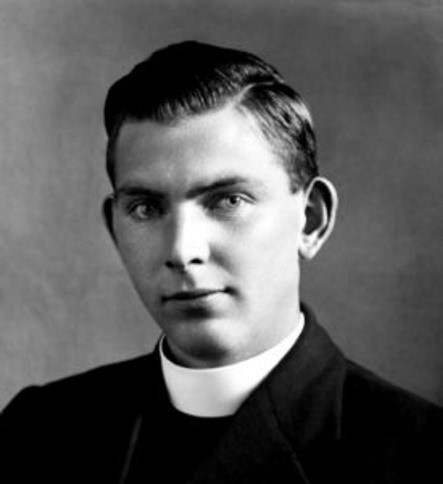
Fr. Paddy Reilly was born in Drumraney, Co Westmeath on October 21st 1915.
He was educated in Drumraney N.S. 1920 – 1929, and in St Finian’s College, Mullingar 1929 – 1934.
He went to Dalgan in 1934 and was ordained on 21st December 1940.
In the Far East September 1956 Father Bernard Smyth wrote a lovely article about a memory he had of Father Paddy at that time:
“And, curiously enough, my most vivid memory of Fr Reilly goes back to that first year. We spent our Christmas holidays in the college and we were, I need hardly say, games crazy. We slept in two separate huts and during the holidays the two huts played each other in Gaelic, soccer, rugby and hurling. As far as I can remember nobody was killed – which is a bit difficult to understand when one recalls the rugby match. Only a few of us knew anything about rugby but we did have the general idea that when an opponent in possession was making for the line our job was to pull him down. This we did with a will, and we enjoyed doing it. At a critical stage in the game Paddy, as he then was, made for our line, but there were four or five of us to intercept him and the situation was safe. Or at least that was what we thought as we went on to attack. What happened during the next ten seconds or so is a bit of a blur, but finally Paddy crossed our line and touched down with an uncertain number of us clinging fiercely but unavailingly to such of his limbs as we could grasp. For he was a strong man, with a strength acquired on his father’s Westmeath farm, and he was never happier in College than when working with a horse and cart.
On December 21, 1940, twenty two students knelt around the high altar in Dalgan Park to receive the priesthood at the hands of the Most Rev. Dr. Browne, Bishop of Galway. Father Paddy Reilly was one of these young men. For seven years we had lived and studied, played and prayed together. That December morning was the climax of those years. It was also the beginning of the parting of the ways. And now, four of that group were dead and gone, and only one, Fr Bernard McCloskey, had died a natural death. Fr Paddy McMahon was killed as a chaplain in wartime France, Fr Frank Canavan died a prisoner in a Communist gaol in North Korea. And somewhere a mile down the road we were travelling Fr Paddy Reilly had taken his last sad look at life and had known that it was his last. It was the end of a journey that began on a September evening in 1934 when our class entered Dalgan.”
Unable to go to Korea because of World War II, he did pastoral work in the diocese of Clifton, England from 1940 – 1946. He was assigned as a curate in Tisbury and Salisbury, Wiltshire, England.
In 1947 Father Paddy was appointed to Korea to the new parish of Mukho a harbour town on the east coast of Kangwon-do. He bought a house and reconstructed it as a Church.
On June 27th 1950, two days after the outbreak of the Korean War, North Koreans invaded Mukho from the sea and troops landed about ten miles to the north. His congregation of twenty-five people fled and he was left alone with his cook. Having no parishioners to care for, he learned that there were Catholic refugees in Man Oo . Father Paddy decided to go there.
He lived in the house of Francis Nam for some time. On one occasion he said Mass, heard confessions and distributed Holy Communion publicly but as there were too many strangers about he did not do so again. Some days later the Communists found and captured him. Father Paddy said to them: “I have done nothing to harm you, nor has my country done anything against yours or any other Communist country Loosen those ropes! I will not flee. There is no place to which I can escape.” They untied him and brought him to Mukho station.
This is the house from which Father Paddy Reilly was captured. The house belonged to Francis Nam.
In the picture is Father Brian Oakley with Francis Nam’s daughter who was about 5 years of age when Father Reilly was killed on August 29th 1950. The Photo Album of the Columban Mission to Korea Volume 3 states: His body was found in January 1951, after the retreat of the Red Army. He was buried at Mukho Naval Base in Pal Han Ri by Colonel Baik Ki So, of the Korean Navy, and chaplain Alexander Lee. The following year he was re-interred behind the cathedral in Chun Chon.
Father Paddy was 35 years old
He was the third of the seven Columban Priests to be killed in Korea
FATHER REILLY’S LAST DAYS
An account of the finding of Father Reilly’s body in Korea and of the events that led up to his death. By Father Brian Geraghty
We have located Father Paddy Reilly’s grave. Here are the events that led up to his death, in so far as they are known.
Communist invasion
He was stationed in Mukho, thirty miles south of Kangnung, in the east of Korea. On Sunday, June 25th of last year, the Reds landed by sea to the north and the south of his parish. Father Paddy left his residence that day to join Father Maginn fifteen miles south in Sam-chok, but for some reason returned home when he had half the journey made. His town was occupied by Reds on June 28 or 29, and on that day he went to a catechist’s house about five miles north-west of the town. He remained with the catechist, Nam Francis, for twenty six days, and in that time the Red army moved very far south.
USUALLY the Reds in the rear of the army were much more severe on the people. It was their custom to set up local administrative centres, including police and propaganda agents, and very little escaped their eyes. Nam Francis, the catechist, was known to be a Catholic and was considered the one man who should be able to inform them of the whereabouts of Father Reilly and his property. The Reds had no idea that Father Reilly was living right in their midst, but they were anxious to get his clothes, supplies of food, and any weapons he might have had.
Taken prisoner
Nam Francis did admit that he had some things belonging to Father Reilly, as he thought that by doing so he might be the better able to save the priest’s life. He was told to take all he had along to Red headquarters, but he was not allowed to return to his home without a guard, and of course the guard saw the priest there. The house was searched, Father Pat beaten up a little, then roped and led to the police-station in Mukho. The catechist was also arrested and taken first to Mukho and later to Kangnung. He was finally released but he never saw Father Paddy again.
His body found
So much for Father Reilly’s arrest. We next hear that an old man gathering pine branches for fuel last year reported, in returning home, that there was a dead body up the mountain path which should be buried. Another old man, anxious to see if the body was within the village precincts and consequently the responsibility of the villagers, went up and satisfied himself on the point, with the result that a few younger men in the village carried out the burial. I have met the second man mentioned, and he tells me that he clearly recognized the dead man as a “foreigner,” with fair hair and very tall, and that he was perhaps two days dead at the time. But apart from knowing that it was the seventh lunar month, the old man could give me no idea of the date.
A young Korean navy officer, a Catholic, came to Mukho last December and ever since has been trying to glean all the news he could of Father Reilly. From all the reports, he gathered that he must have been killed in a certain locality, which helped him considerably by narrowing down the enquiry. While people here are very slow to answer such questions in detail, he was enabled eventually to meet the old man referred to, who had seen to the burial, and who now led him to the grave. The officer questioned the old man concerning the clothes, height, colour of hair and other details of the dead man, and then questioned Nam Francis to see if the old man’s answers tallied with the catechist’s memory of Father Reilly when he had last seen him. Afterwards the officer opened the grave and had the remains removed and buried in Mukho. He would have preferred to have some or all of us priests present for the exhumation and re-burial, but as the Reds were again only a few miles from Kangnung he thought it better not to delay. He did send a letter and last week I drove to Mukho and once again opened the grave. While very little but the bones remain, I was able to recognise the dental formation as Father Pat’s; he had long and somewhat irregular teeth. I have no doubt about the remains and I left him there to rest along-side the place where he was to have built a church last September.
A possible explanation
My opinion is that he was being walked from Mukho to Kangnung, and that after he had completed ten or twelve miles he became weak and his guard shot him. That was their way of dealing with any prisoner who could not continue on a journey. He was shot in the chest; and just as his short life here in Korea was spent doing his work very quietly, so also in death no one but his executioner and God knew about it. As I placed his bones to rest once more I offered a little prayer to him to comfort his family at home, to bless the parish and people for whom he gave his life, and to help the Society that had called him to the priesthood. Pagans and Catholics joined in doing their very best to give him a decent burial, and I think the Navy officer deserves a special word of thanks.
I visited Kangnung and Samchok also but so far I have been able to gather no reliable information about Father Maginn. I still have hope that some-day we shall learn all, but at the moment people are very much afraid to speak of such matters. We have true information now on the fate of Father Collier and Father Reilly, and we may yet hope for correct news of the fate of our other missing men.

On October 11 1951 the remains of Father Tony Collier and Father Paddy Reilly are carried in procession to the bombed Cathedral in Chunchon, where Requiem Mass was celebrated.
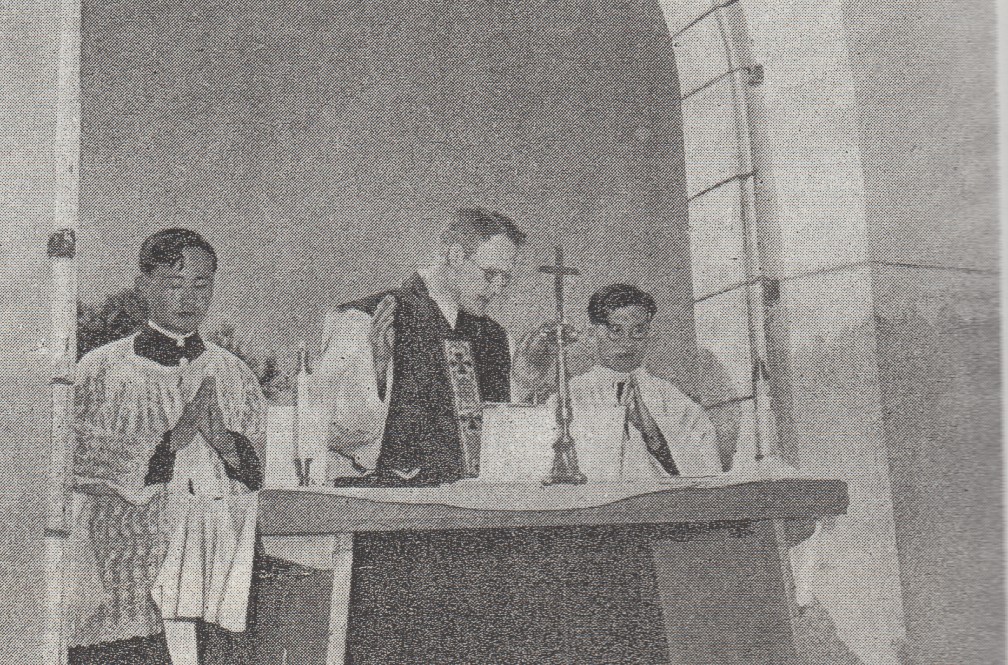
Father Geraghty celebrates Requiem Mass for Fathers Tony Collier and Paddy Reilly at the altar set in the doorway of the ruined Cathedral.
- Details
- Hits: 4615

“I’ll have my Christmas Dinner in Heaven”- Fr Frank Canavan (1915 – 1950) by Mairéad O’Brien First published in JOTS 19 (Journal of the Old Tuam Society), pages 34 – 43.
Missionaries are often called upon to risk their lives for their faith. Since 1929, twenty-three Columban Fathers and one Columban Sister paid the ultimate price when they answered that call. Fr Frank Canavan was one of the seven Columbans who died the death of a martyr during the Korean War (1950-53).1 At the outset of the conflict, he had the opportunity to remove himself from danger but committed to his mission, and with no thought for his safety, chose to remain, thereby sealing his fate.
Early Years
Francis John Canavan was born in Headford in February 1915 to shopkeepers Joseph Canavan (1862-1932) and Eliza (Lizzie) Kyne (1874-1955), the second youngest of their nine children. After finishing his primary education in Headford NS in 1929, he enrolled at St Mary’s College in Galway, where his mother’s first cousin, Canon Peter Davis, was President
When he left St Mary’s, he decided to join the priesthood. Fr Andy Moran, his parish priest, wrote him a glowing letter of recommendation which summarised him perfectly: ‘his piety and character will pull him through where strong men would fail.’ He is ‘quiet and conducts himself well, steadfast I should say, very tenacious and persevering.’ These were qualities which would stand to him.
In 1935 he joined The Society of St. Columban, also known as The Maynooth Mission to China. The society had been formally launched in 1918 by Fr John Blowick from Belcarra, Co Mayo and Fr Edward Galvin from Cork. Having received approval from the hierarchy, they leased Dalgan House, Shrule, Co Mayo, where they opened a seminary. In 1927 the society bought Dowdstown House in Navan, Co Meath, renamed it Dalgan House and moved its operations there.2 The building was in poor condition and due to a lack of funds the new college only received its first students in 1941. Frank was ordained in Shrule in December 1940, one of the last to be ordained there.
Kinvara
Due to travel restrictions during World War II, some Columbans were sent to parishes in England, but that option was not open to Fr Frank. Threatened with an ulcerated stomach, he was required to remain in Galway where he followed a special diet until his health improved. He ministered in Oughterard from 1943 to 1945 and then in Kinvara until 1948, when he got word that he was being posted to South Korea. Maura Mongan (née Muldoon) and her brother Kevin have vivid memories  of Fr Frank’s departure from Kinvara. Their parents, Joseph and Sarah Muldoon, were both school teachers in the local boys’ school and were well acquainted with him. Maura was only a child and many decades have passed since that farewell but the palpable emotion and solemnity of the evening served to embed the events in her memory. Usually, Maura and her siblings, like all children back then, were told to stay out of the way when visitors called, but this night they were allowed to remain. Fr Frank asked them all to kneel as he blessed each of them individually. Her mother, Sarah, was visibly upset at the thought of this gentle soul heading off to a ‘Godless’ country so far away. To console her, he gave her his rosary beads which she always cherished. In her final years of illness, ‘Fr Canavan’s rosary beads’ gave her comfort and were entwined around her fingers as she drew her last breath.
Maura’s brother Kevin did not hold onto that same memory but he can recall his excitement when he received Fr Canavan’s bicycle. The priest, having no further use for it, gave it to the young lad. Whether it was purchased or gifted, Kevin cannot recall. He does remember that it was a godsend to him – he could now cycle the ten kilometres round trip for his music lessons in the convent in Kinvara.

Chuncheon, Kangwondo Province, South Korea
In January 1949, following a holiday at home, Fr Frank embarked on the next chapter of his life, not realising that it would be a short chapter and his final one. Setting out from Cobh, his first stop was New York where he visited his Canavan cousins and climbed to the top of the Empire State Building. From there he travelled to Korea. His new parish, Jungrim Dong, was in the city of Chuncheon which lay close to the border with North Korea. When he arrived there, he immediately began to get to know the people and their culture and to learn their language. Initially, he found it difficult to stomach the local food, but with persistence, he grew accustomed to it.
Although he had a serious side, he was also blessed with a dry wit. In his letters home, he entertained his mother with stories of removing his shoes before entering a home and sitting on the floor rather than on chairs. He also wrote about the threat of invasion from North Korea, which was always bubbling in the background. He made light of the prospect by suggesting that if he was killed, his mother could cut up his old coat and sell the strips as relics in the shop. One can only imagine the conversations over the shop counter in Headford as his mother relayed these snippets from Korea. He joked, somewhat prophetically, with his sister Meg about his Korean name, which was Fr Sohn – “Now that I am Sohn (sown) in Korea, I hope I will bear good fruit.”
War Breaks Out
After World War II, Korea was partitioned along the 38th parallel, thus becoming two sovereign states: North Korea was backed by Communist Russia and South Korea by the West. Tensions constantly smouldered between the two ideologies, and at 4 a.m. on Sunday, June 25, 1950, the North Korean Peoples’ Army launched a blitzkrieg attack on the Republic of South Korea. American President Harry S. Truman quickly directed General Douglas MacArthur, the commander of the forces in the Far East and Japan to provide support to the struggling South Korean military. Western nations also pledged to send troops and MacArthur was given command of this combined United Nations forces.
 At the outbreak of the conflict, forty-two Columban priests were posted in Korea, two-thirds of whom were Irish-born. Monsignor Tom Quinlan, who was the Prefect-Apostolic, Fr. Hubert Hayward, Fr Pat Burke and Fr Canavan were living at the mission in Chuncheon. Fathers Hayward and Burke had gone to Seoul the day before the attack and could not return afterwards because of the invasion.
Although the war had been brewing for some time, the attack took people by surprise. That Sunday morning, as Fr Phil Crosbie made his way from his parish in Hongchon to visit his confrères in Chuncheon, he did not pay too much heed to the sound of gunfire - he thought it was just another minor incursion by the North Koreans. He was looking forward to chatting with Fr Frank – they had studied together for four years in Shrule and had only met recently for the first time in eight years. At that meeting, Fr Crosbie had noted that his friend had changed little, except that “the
burden of chronic illness lay heavier on him.” As a child, Fr Frank contracted double pneumonia and measles – both illnesses leaving him with a weakened constitution. Then, when he was studying in Dalgan, a bout of influenza took a further toll on him.
That evening, as they sat chatting, the American adviser to the South Korean forces in the province called to advise them to leave, offering them transport south to safety. Msgr Quinlan had decided to remain with his parishioners and made it clear to Fr Frank that he had his blessing to go as he was still only a language student. Even though he had already decided to stay, Fr Frank discussed his options with Fr Crosbie, who gave him many good reasons to leave the danger zone. Although he had no official pastoral role, Fr Frank wished to keep Msgr Quinlan company and to help him guide and protect their flock in this time of great danger. The Monsignor, understanding the young man’s strong desire to remain, allowed him to do so. The following morning, as Fr Crosbie made his way back to Hongchon, he thought of Fr Frank and the image “of a small sick man with a smile in his eyes and peace in his heart, turning his face to a gathering storm” came to mind.
The presence of North Korean soldiers increased over the next couple of days. Shells landed in the Columban compound, setting fire to the old church. Bullets ricocheted around the place. Artillery fire was sometimes so loud that they could not hear themselves speak as they sheltered in the relative safety of their almost completed new cathedral. Msgr Quinlan later commended the “heroic courage” displayed by Fr Frank under this barrage.
Arrest
On July 2nd, as Msgr Quinlan was celebrating Mass, North Korean soldiers burst in, looted the place and arrested the two men. The soldiers marched them, hands in the air, to army headquarters, where they were incarcerated for a few weeks. Major Chong Myong Sil, the man who would later lead them on the infamous ‘Tiger Death March’, repeatedly interrogated them about their general family background, schooling, and political and religious affiliations. The rations of food, which consisted mainly of boiled rice and pickled turnips, were paltry – whereas the hunger was terrible, the thirst was worse.
In the meantime, Fr Crosbie had been arrested and was also imprisoned there. He later described the feeling of relief he experienced when he heard the two familiar voices of Msgr Quinlan and Fr Canavan replying as their names were called out at roll call. Some days later, he heard them being taken away and feared that they were going to be executed. A week later he himself was taken out and was preparing himself to die when, to his great relief, he found himself at the main gate of the jail with none other than Msgr Quinlan and Fr Canavan. Capture by the enemy can be terrifying, but it is comforting to know that you are not alone!
Seoul
The three men were then transported by train to Seoul. There they were thrown into an overcrowded basement with up to one hundred men, women, young children, diplomats and members of religious orders. The Catholic religious included His Excellency, Bishop Byrne who was the Apostolic Delegate in Korea, his secretary, Fr Booth, some French Fathers of the Paris Foreign Missions, three of whom were between the ages of 75 and 82, two Sisters of St Paul of Chartres, one of whom was 76 and five Carmelite Sisters one of whom was blind. Among the other religious was Mother Mary Clare Whitty from Fenloe, Co Clare, the 67-year-old Anglican Superior of the Holy Cross Society in Seoul. There were two family groups, both of whom survived the war: a Tatar couple had six children between the ages of one and eighteen years, and a Russian couple had three children aged two, five and eight.
Despite the extreme heat, the windows were kept tightly shut. The stifling atmosphere, hordes of flies, fleas and mosquitoes and meagre rations of food and water wore them down physically. To demoralise them, their captors played cruel mind games, keeping them in a constant state of fear. From the torture chamber above them, they could hear the moans and cries of prisoners who refused to renounce their faith, denounce Capitalism and embrace Communism. Sometimes these torture sessions were staged to intimidate the prisoners but sometimes not, and the prisoners could not tell the difference.
Fr Frank had managed to bring his books with him and with the help of Fr Crosbie, continued studying the Korean language. After several days in Seoul, the group was packed onto a train bound for Pyongyang, the capital city of North Korea. The train slowly made its way for thirty-six hours, standing in stifling heat in sidings by day and moving only after dark to avoid detection by South Korean forces. For the first twenty-four hours they were not even given a drink of water.
Pyongyang
In Pyongyang they were interned for two months in a school which had been converted into a concentration camp. Both the quantity and quality of the food were poor here and they were edging closer towards starvation. They were not allowed physical exercise but the monotony of their days was sometimes broken by card games – one of the French diplomats had the foresight to bring a deck. Even without the common bond of language, they managed to form a cohesive group.
Manpo
In September 1950, General MacArthur executed a daring amphibious attack on the coastal town of Incheon in South Korea. By October, American troops had advanced into North Korea. News of MacArthur’s arrival raised the prisoners’ hopes of an early release, but it was not to be. Chinese troops entered the war on the North Korean side prolonging the conflict.
 In early October, the group was moved northward ahead of the advancing Americans to Manpo, a town close to the Chinese border on the Yalu River. Here they received some cottonpadded clothing – everyone got a jacket, but there were not enough trousers to go around. The quality and quantity of the food also improved and they were allowed to wash themselves and their clothes in the Yalu River. About 700 American prisoners of war who had been captured in the early stages of the war joined them here – many of them were wounded and all of them had been brutally treated. On Sunday mornings, the Catholics, who constituted one-third of the civilian group, recited the rosary and sang hymns, using Latin as a common language. For the priests in the group, being prohibited from saying Mass was worse than all the other deprivations and physical trials. When Msgr Quinlan celebrated his first Mass after his release in 1953, he was so overcome with emotion that he broke down in tears halfway through.
There were a few light-hearted episodes provided, unwittingly, by Fr Frank and appreciated by all. One was related to a precious cup of water that he had managed to procure. It was so cold in Manpo that to obtain drinking water, one had to hack out chunks of ice from the water supply with an axe and then melt them in a pot. Fr Frank had gotten hold of a mug of boiling water from such a pot. He left it on the window sill to cool. In the meantime, he became engrossed in a hand of bridge. One of the guards arrived to borrow a safety razor from one of the prisoners. When he saw the mug of hot water, he decided to use it for shaving. He grabbed a mirror and soap and started the process. When Fr Frank looked up from his game and saw what was happening, he was outraged, and took the mug and threw its soapy contents out the window. Dumbfounded at first, the guard exploded in a torrent of verbal abuse. Fr Frank, who had little Korean, did not understand what was being said but certainly understood the body language. Fortunately, Msgr Quinlan’s diplomatic intervention calmed the situation.
Over the next few weeks, because of strafing by American aircraft, they were moved to nearby Kosan, from there to Jui-am-nee, an old mining town and then back to Kosan. The acquisition of a rare ration of soya beans provided another diversion to break the monotony of camp life. The Korean men in their group took charge of cooking the beans – carefully washing them and placing them in a cooking pot with just the exact amount of water. They boiled the beans until they were soft and most of the water had boiled off. Then they damped down the fire to allow the remaining water to evaporate slowly, thus, cooking the beans to perfection. Happy that everything was under control, they left the pot unattended. In the meantime, Fr Frank spotted the beans sitting in a pot with little or no water. Thinking that they were going to burn, he quickly poured a bucket of cold water over them, thereby turning what should have been a rare delicacy into a pot of flavourless mush. After he died, the Koreans reminisced with affection about the day Fr Frank had unwittingly ruined their precious ration of beans.
“Then let them march till they die. That is a military order”.
They returned to Manpo, where Major Chong Myong Sil took command of the prisoners. Nicknamed ‘The Tiger’ because of his love for killing people, he addressed the group through a translator, mocking the missionaries and calling them parasites. The prisoners were told to discard everything that could be used as a weapon and that included the walking stick of the eighty-two-year-old Fr Villemot. ‘The Tiger’ informed them that that they would be marching at military pace to Chunggang, a town about 145 kms away. Anyone who dropped out without his permission would be severely punished. The senior civilian, British Commissioner Herbert Lord of the Salvation Army protested that over forty of the group – children and exhausted and elderly prisoners – would struggle to keep a fast pace. ‘The Tiger’s’ response was brief and chilling and a harbinger of what was to come – “Then let them march till they die. That is a military order.” The captives were then divided into groups of forty to fifty, with a U.S. army officer responsible for each group.
The ‘Tiger’ Death March On the evening of October 31st, the prisoners set out in a long, slow, pitiful column of men, women and children, with the American soldiers in front and the civilians bringing up the rear. All the prisoners were struggling from the onset – the cumulative effects of three months of captivity – exhaustion, malnutrition, dehydration and dysentery – had taken a physical toll. Most of the prisoners were captured in July and were wearing summer clothes. Some people did not even have shoes, and others had handmade cloth ones. Their thin blankets offered no protection against the North Korean winter. The Carmelite Mother Prioress, Mother Thérèse, had to leave her sick bed to join the march and Fathers Crosbie and Canavan walked one on each side of her, supporting her as she struggled to keep up. On the second full day, when she felt faint, with the help of two others, they carried her for a while on a makeshift stretcher using a blanket and two straight branches, taxing their strength.

Sketch of the Death March by Corporal Carl V. Cossin of Columbus, Ohio (Courtesy of the National Park Service, Andersonville National Historical Site, ANDE3474)
The guards continually harassed the slower prisoners using bayonets and rifle butts to hurry them. Captain Sir Vyvyan Holt, the British Minister to Seoul, who was part of the group, frequently but unsuccessfully fought the case of the Columbans with their captors, stressing that they were men of God and proclaiming that Ireland, the country of their birth, was a neutral country.
As the march continued, prisoners began to drop out, too weak to continue. ‘The Tiger’ became so enraged that he decided to shoot the section leader who had lost the most men. That section leader was thirty-four-year-old Lt. Cordus Thornton from Texas. When asked why he allowed his men to disobey orders and fall out, Thornton replied, “Because, sir, they were dying.” When asked why he did not order other soldiers to carry them, he replied that he would then be condemning the carriers to death from exhaustion. Following a kangaroo trial, ‘The Tiger’ publicly executed Thornton with a bullet to the back of the head.
At the end of each long day, the prisoners had to squat on their heels in the cold and listen to 'The Tiger’ ranting about the evils of Capitalism and the benefits of Communism. For the first two nights, the prisoners slept in frost-covered fields, huddled together for warmth using corn stalks for cover. Some tried to dig holes in the frozen ground for protection against the elements and many succumbed to frostbite. Meals, which consisted mainly of a ball of half-cooked corn or maize, were infrequent and irregular. ‘The Tiger’ became so frustrated with the time it took to feed the large number of prisoners that he often ordered the march to recommence before they had all been fed.
At one stage, two-thirds of the prisoners were carrying the other one-third. Fr Frank, who was not a robust man, was always on hand to help, exhausting himself. As the march progressed, several prisoners sat by the side of the road, believing that an oxcart would pick them up and carry them the rest of the way. They were mistaken, and the sound of gunfire heralded their executions.
After the second full day of marching, they were allowed to sleep indoors in a small schoolhouse. The diplomats and civilian families were housed in one room. The remaining civilians were packed tightly into a room in which the Columbans were allocated a small corner. As the room filled up, a general melee erupted outside as the prisoners-of-war attempted to push their way in – to be left out in the cold meant certain death as temperatures dropped as low as -50⁰ C. Cramped muscles, body odours and the smell of dysentery created a suffocating atmosphere in the darkened room that night. Forced to remain seated with knees tucked into their chests, most of the prisoners were unable to stand in the morning and had to crawl from the room.
That morning the women in the camp were told that transport was being arranged for them. After the main column had departed, it became clear that there would be no transport, and they were forced to set off without the usual assistance of the men. Around midday, following an uphill march, the exhausted women re-joined the main group. Two of them – seventy-six-yearold Carmelite, Mother Béatrix and Mrs Funderat, a sixty-nine-year-old Russian widow – unable to keep up, had to be left behind and were subsequently executed. As the march progressed that afternoon, several American soldiers, exhausted, sat down by the side of the road. The sharp crack of rifle shots could be heard soon after. That night their accommodation was a little more spacious – the civilians slept in a chapel and the remainder in a nearby school.
On the morning of the fourth day, snow began to fall as they approached a series of mountains, making conditions treacherous. They set out early at a rapid pace as ‘The Tiger’ needed to get through the Chasong pass before snow blocked it. The climb became steeper, the snow became heavier, and the biting Manchurian wind penetrated to the very marrow of their bones and took away the little breath they had left. They slaked their thirsts by eating small pieces of ice that clung to the shrubs and those without shoes left bloody footprints in the snow. Execution was the price exacted for being too exhausted to continue, and the bodies were summarily dumped over cliffs – to hinder later identification, their ‘dog tags’ were removed from the American soldiers. By late afternoon, the prisoners had negotiated the pass and reached the town of Chasong.
Here ‘The Tiger’ relaxed the pressure on the civilians but the American soldiers were given no quarter. Commissioner Lord and Msgr Quinlan argued successfully for transport for the weaker civilians. Oxcarts arrived to bring the women and children and the old and sick men the remainder of the way to Chunggang, their journey’s end. Here they were housed in an abandoned schoolhouse. Sr Mary Clare, the Irish nun, survived the march but died from exhaustion on November 6th, 1950. It was a few days later – November 8th – before the remainder of the marchers arrived. Over the eight days they had covered 146 kms of mountainous terrain in sub-zero conditions, losing ninety-eight American prisoners-of-war and two civilians
Chunggang - From Death March to Death Camp
Conditions sank to new lows in Chunggang. Rations were estimated at four hundred grams of rough grain per day and drinking water was scarce. Older people, who had lost their teeth through neglect, found it difficult to eat the food. Fatigued and starving, survivors now began to perish from a variety of ailments, most notably pneumonia and chronic dysentery.
‘The Tiger’ insisted that all the prisoners conduct outdoor physical training each morning. Although the temperatures were sub-zero, the prisoners had to strip down to their shirts. After the first morning of these exercises, Fr Frank and Bishop Byrne became feverish and developed coughs. Pneumonia set in very quickly.
At midnight on November 16, after the camp was blitzed by American fighter aircraft, the prisoners were moved to Hachangri, about three miles from Chunggang. Bishop Byrne and Fr Frank and those who were too sick to march were brought to the new camp in ox carts. When they arrived there, they had to stand around for an hour in the cold until a house became vacant for them. Their accommodation was cramped, but at least it was heated.
Here North Korean army medical personnel visited the camp. Through their incompetence and lack of medicines, they lost more patients than they saved. The sick were transferred to a ‘hospital’ nearby. A thick layer of frost covered the walls, and the patients were given two straw mats, one to lie on and another to use as a blanket. The ‘hospital’ was simply a few squalid flea-ridden hovels where ill prisoners were brought to die – the chances of survival were so poor there that it became known as the ‘morgue’.
Msgr Quinlan managed to get special rations of white rice and sugar for the two sick priests, who could not eat the rough Korean food. He was in constant attendance on them and never once did either of them complain. For a time, he succeeded in hiding the fact that they were ill but eventually, they were ordered to go to the ‘hospital’. Fr Frank walked there, but Bishop Byrne had to be carried, and on the morning of November 25, he passed away peacefully.
“I'll have my Christmas dinner in heaven”
On December 4, Fr Frank was allowed back to the main camp. That evening it was clear that he was still unwell. The next day he was worse, and as he was led away to the ‘hospital’ for the second time, the others attempted to cheer him up by telling him that they would all be eating Christmas dinner in the free world. “I'll have my Christmas dinner in heaven,” he replied prophetically.
Msgr Quinlan stayed with him on the night of December 5. Fr Frank’s tenacity and perseverance had sustained him throughout his internment and carried him along on the Death March. His body, already weakened by his childhood illnesses, could take no more. He took his last breath on the 6th December, the feast day of St Nicholas, patron saint of Galway – a saint to whom he had a great devotion. The Monsignor laid out his body, clothed in his light summer soutane. That evening they hacked a shallow grave in the frozen ground and buried him near Bishop Byrne.
 Aftermath
The war in Korea dragged on for three years. The whereabouts of nine missing Columbans was a cause of great concern in Ireland and abroad. It was only when the surviving priests were released in April 1953 that it was confirmed that seven out of the nine missing men were dead – only Fr Crosbie and Msgr Quinlan had survived.
Fr Crosbie travelled to Headford to personally offer his condolences to Fr Frank’s mother and sisters. For the Canavan family, hopes of a homecoming were dashed. There would be no chance to say goodbye and no grave to visit – only precious words of comfort from a man who had shared Fr Frank's final ordeal. They were consoled by the knowledge that, after five months of brutal captivity, their son and brother, having received the Last Rites, passed away peacefully in the company of a friend – his place in Heaven guaranteed.
Fr Frank lies in an unmarked grave in North Korea. Today a granite Celtic cross with his name stands over an empty grave in the burial plot behind the cathedral in Chuncheon. His name is also engraved on the family gravestone on the floor of the ruins of Ross Errilly Friary, Co Galway and on a memorial plaque in the grounds of Headford church. A memorial to the seven Columban martyrs and Sr Mary Clare was erected in Yongsan-gu, Seoul, in 2013 by the Embassy of Ireland to Korea, the Irish Association of Korea, the Irish Government and other associations.

L to R: Memorials at Ross Errilly Friary and Headford Churchyard (Courtesy of Mary Burke), Memorial in Seoul (Courtesy of Herstoric Ireland)
Death March Casualties
A precise account of casualties is difficult to establish. Approximately 800 prisoners marched out from Manpo on October 31st. According to Private ‘Johnnie’ Johnson from Ohio, who secretly kept a list of casualties on scraps of paper, 496 prisoners from their group died in captivity throughout those three years. Those who avoided execution died from various ailments brought on by starvation, dehydration, exposure, ill-treatment, the gruelling pace and lack of medical care. Those who survived were reduced to skin and bone. Nobody knows what happened to ‘The Tiger’ – and according to military sources, it would be almost impossible to find out.
Epitaph
In a tribute paid by Msgr Quinlan to Fr Frank in 1997, he summed up the young priest’s commitment to his calling – “no words of mine could sufficiently extol his priestly virtues.” One of Fr Frank’s greatest virtues was his Christian love for his fellow humans which can be encapsulated thus: ‘I am the good shepherd. The good shepherd lays down his life for the sheep’ (John 10:11). Although depleting his limited reserves in the process, he continued to help the sick and the old who could not keep pace on the Death March, bringing them spiritual comfort and giving them a chance to live another day.
Fr Frank is one of the eighty-one modern-day martyrs whom the Korean Catholic Church is promoting for beatification. In 2014 they were declared Servants of God – the title granted to individuals at the first stage of canonisation. Their cases were discussed last June at the South Korean’s Special Episcopal Commission to Promote Beatification and Canonisation. As ‘witnesses of modern and contemporary faith’ of the Korean Church they were declared worthy of the status of sainthood. It will nevertheless take a few years before Headford can pay homage to its first saint.
Appreciation
Sincere gratitude to historian Fr Neil Collins SSC for his generosity in giving of his time and sharing information and photographs. Thank you to Gearóid O’Broin and Hugh Byron, nephews of Fr Canavan; Maura Mongan, Kevin Muldoon and Very Rev. Dr Hugh Clifford, Kinvara; Kevin Flood and Fr Ray Flaherty, Headford. As always, thank you to Gerry O’Brien and Mary Burke.
Sources
The Far East - Magazine of the Columban Missionaries
W. C. Lathamx, ‘Ordeal of the Tiger Survivors’ Army History 75 (2010): pp. 6–17 Carmel and the Korean Death March by the Carmelite Nuns of Seoul, South Korea.
Philip Crosbie, March Till They Die (Brown & Nolan, 1955)
Fr Neil Collins SSC, A Mad Thing to Do – A Century of Columban Missions (1916-2016) (Dalgan Press, 2017) Roger Hermiston, The Greatest Traitor: The Secret Lives of Agent George Blake (Aurum, 2014).
Gearóid O’Broin, ‘Fr Francis Canavan’ in Roots of Faith: A Journey of Hope to mark the 150th Anniversary of St. Mary's Church, Headford (2015) https://columbans.ie/about-us/columban-martyrs/.
The Irish Catholic
-------------------------------------------------
1 Fr. Tony Collier (37), from Clogherhead, Co. Louth was killed on 27th of June 1950; Fr Jim Maginn (38), of Newcastle, Co Down (was born in Butte, Montana to Irish parents who returned home to Newcastle when he was nine), was killed on 4th July 1950; Fr. Patrick Reilly (34) from Drumraney, Co Westmeath was killed on the 29th of August 1950; Monsignor Patrick Brennan (49), born in Chicago, Fr. Tommie Cusack (39) from Ballycotton, Liscannor, Co Clare and Fr. Jack O’Brien (31) from Donamon, Co Roscommon were killed on the 24th of September 1950 at the Massacre at Taejon.
2 Dowdstown House was purchased for £15,000. It was the international headquarters of the Columban Fathers until 1967 when they moved to Dublin. In 1981 it was re-dedicated for use by Meath Diocese as a retreat and pastoral centre and was named after Fr John Blowick, one of the founder members.
ARREST IN KOREA
By the Right Rev. Monsignor Quinlan (Far East June 1953)
The invasion of South Korea by the North Korean army began at 4 a.m. on Sunday, June 25, 1950. Our mission headquarters in Kangwondo was only twelve miles from the border. During the 6 o’clock Mass we could hear the sound of guns; before the last Mass and Benediction were over at 11 o’clock the sounds had grown considerably louder. We thought at the time that it was just another of the Northern raids, and the radio had not yet given news of the general attack over the whole line.
Fathers Hayward and Burke
Father Hayward and Father Patrick Burke had business in Seoul. I told them to go ahead and tend to it. They were to return on Tuesday and little they or we thought that on Monday the road back would be cut off by a strong, well equipped Red army. Father Frank Canavan and I wished them a good journey and jokingly told them not to let the Reds get them. Then we settled down to catechism classes, examination and instruction of catechumens, and other routine Sunday classes.
By 6 p.m. the radio carried the news of the invasion over the 38th line at all points. The townspeople grew uneasy and many began to flee by train and truck to Seoul.
Father Tony Collier was stationed in a new mission in another part of the town. He visited us on Sunday evening and told us that a few Koreans near his mission had been wounded by stray bullets and that he had given them first-aid treatment. His mission was overlooking the bridge which spanned the river between the city and the oncoming Red army. I thought severe fighting would occur around the bridge and I asked Father Tony if it would not be better to abandon his mission and come to ours, which was a good distance away from the bridge. I shall never forget his answer. “I would prefer to stay with my own Christians. Short of a direct hit by a shell I shall be safe in the residence and I may be able to help my people if the Reds capture the city. I’ll be seeing you,” he replied, and returned to his mission.
That was the last time I saw dear Father Tony, and not until I returned to Ireland was I to learn the story of his death.
In this, the first of three articles on his war-time experience in Korea, Monsignor Quinlan tells of the battle for Chuncheon and his own and Father Quinlan’s arrest. An incident leads him to believe that Father Collier had been shot, though he had to wait until his return to Ireland last April for confirmation of the fact.
“We Shot an American”.
But an incident on Thursday, June 29, made me uneasy for him. An officer was looking at the new church building as I came up for Mass. He covered me with his rifle and asked my nationality. I told him, and my Chinese contractor assured him, that I was Irish. “We shot an American in town the day we arrived here,” he said. “But there were no Americans here,” I told him, “where was the man you shot?” “Up there,” he replied, pointing in the direction of Father Tony’s church. For us priests to go on the street would have meant certain death and I had to be content with asking some Catholic women to try to get to Father Collier’s church. They made the attempt but were turned back.
Later another Korean officer called. I told him of my fears for Father Tony and asked him to take me to his mission. He refused, but promised to go and see and come back to let me know. He went away but never returned. Next evening (July 1) I got in touch with a local communist who had a pass from the Red army and could go about the town as he liked. He promised to return next morning, but when the morning came we had been arrested.
Citizens Flee from Chuncheon
I return now to the events of that first Sunday evening.
By 10 p.m. the sound of the guns was very near and the occasional shell was reaching the outskirts of the town. On Monday morning the exodus of the townspeople was in full swing; people with bundles on their heads, in their hands, people leading or carrying children, old people, young people – they went by the main road to the south, over by-roads, over the hills and away from us. By noon most of the 60,000 inhabitants had fled. I think not more than 500 people were in the town on Monday evening.
To Go, or Stay?
On Monday afternoon Major Hogge, The U.S. military adviser to the South Korean forces in the town, called to see us. He told us he was leaving and going south to Wonju, and offered to take us with him. I asked if he knew what was the United States policy towards the invasion. (If the United States was going to take a hand, I thought, the invasion would be rolled back soon; and in that case we would have gone with Major Hogge.) He told me that he did not know. Then I replied, “We shall stay. Our place is here with our Christians.”
I turned to Father Canavan and said to him, “Father Frank, what do you want to do? You have no charge of souls here, no district for which you are responsible. You are free to go, and if you want to go I shall give you my blessing and think as much of you as if you stayed.” He thought for a minute or so, and then he replied, “If you will allow me, I should like to stay here with you to help. I can hear confessions.” “ Father,” I replied,” this may be final for all of us. We shall not have an easy time with the Reds and may even lose our lives. If you want to go, this is your last chance.” “ I want to stay,” was his reply. Major Hogge said goodbye to us and left.
On Monday night I told Father Frank to consume the Blessed Sacrament, and a little later we went to shelter in the new church, which was strongly built. Shells had been falling around the mission compound and on the road below it, which leads to the south; bullets were pinging all over the place. We settled down to spend the night in the new church. Father Frank and I and some of our Catholics who had not gone away, lay around against the granite wall. On the stroke of midnight the real battle for Chuncheon began. Both sides gave all they had; artillery, machine-guns and rifles were blazing away. We could not hear each other’s’ voices. After about half an hour it ceased and for the rest of the night no firing occurred.
At dawn the attack was renewed. By 8 o’clock in the morning we could see the South Korean troops evacuating the town. About 9 o’clock a shell made a direct hit on the roof of the new church. It crashed through the roof but did not start a fire. A few minutes later another shell fell on the old church a little below the new building, and fire broke out immediately. Telling Father Frank to remain in the new building until I called for him, I went down to the old church to see if a few buckets of water would extinguish the fire. Just as I got there another shell fell quite near it and I decided that it would be foolish to go on the roof.
Ten minutes later the shelling and rifle fire completely ceased and I called Father Frank and the servants from the new building. We started to haul water in buckets from a sixty-foot well in an effort to extinguish the fire on the roof, but all we succeeded in doing was to keep it from breaking into a great flame and spreading to neighbouring houses. Some of us worked on the roof, others began to clear out the church furnishings; altars, vestments, harmonium, stations of the cross.
First Meeting with Reds
At about 10.30 in the morning we had our first encounter with two soldiers of the North Korean army. They came into the compound with their rifles at the ready. I was hauling water from the well and Father Frank was standing beside me to pass the bucket on to the next person. The soldiers covered us with their rifles and I said to them in Korean: “ How do you do? Can we offer you a drink of water?” They came up to us, their rifles still covering us, and one of them said to me,: “Comrade, who are you? “I am a Catholic priest,” I replied. “Are you American?” he asked. “No, I am Irish and proud of it,” I said. “You speak Korean well. When did you come here?” “I have been here for twenty years,” I said. He grew a little more friendly, though he didn’t lower his rifle. Turning to Father Canavan he asked: “ And who are you?” “I, too, am Irish,” replied Father Frank in Korean. “What are you doing here?” came the next question. “A shell fell on our church and set it on fire, and we are trying to keep the blaze from spreading to the neighbouring houses,” was the reply. “That is good work. Carry on, comrades.” Then they left us.
All day long until 11 0’clock that night Father Frank and I with a few willing Korean helpers doused the burning building with buckets of water. By then the roof had collapsed and the danger of the fire’s spreading to the neighbouring houses was over. At 11 0’clock it began to rain heavily. The fire was now only a smouldering one and we were dead tired, so we left off work and lay down just as we were. Next morning we continued working on the church, sousing the smouldering patches, putting the vestments away in one room of the residence, and clearing up the mess as best we could. So we spent the day – Wednesday June 28.
Communists Again
No Red soldiers bothered us that day or the next. On Friday and Saturday we had visits from some of them, who looted my house of everything but did not touch the one in which Father Frank was living. On Sunday, July 2, Father Frank said his Mass first and I began immediately after him. Up to then all had been quiet, but just as I began the Gloria rifle shots rang out in the yard. A North Korean army officer and about five soldiers rushed into the room next to the one in which I was offering Mass and with their rifle butts they smashed the glass in the windows and bookcase and began to throw everything about. They next entered the room in which I was offering the holy sacrifice. The officer saw a small statue of the Blessed Virgin on a low press. He took it in his hand, raised his hand above his head, then smashed the statue against the floor.
I stopped, and turning to him in my vestments I said: “Why are you doing this? Your headquarters here in town know that we are here. They will not be pleased with what you are doing.” A few Catholics had been kneeling at Mass. Terrified at what they had seen, they rushed out into the yard and tried to escape. A soldier fired at them (fortunately he did not hit them) and they returned very frightened. Then an officer searched Father Canavan. He took away his watch, his fountain pen, everything he had in his pockets, and ordered us into the yard. I took off my vestments and walked into the yard with Father Frank.
Arrest and Interrogation
There we were told to put up our hands and march before the six braves through the town to headquarters. At headquarters we had a long argument with the senior officer about our nationality, the existence of God, the existence of the soul and various other topics until about 11 o’clock in the morning. Then he sent us to the newly-arrived Internal Security forces under guard. They continued to question us until 7 o’clock that evening. At 7 o’clock one of the security officials said: “I know all about the history of the Catholic Church in Korea. Tell me all and leave out nothing.” I replied: “Since you know all about the Catholic Church in Korea, and since neither of us has had even a drop of water since we got up at 6 o’clock this morning, would you mind if I don’t give you the history you asked for just now?” He became a little more friendly at that and promised to get us some water and some food to eat.
THE LONG CAPTIVITY
By the Right Rev. Monsignor Thomas Quinlan (Far East August 1953)
In last month’s issue of the Far East Monsignor Quinlan described the arrest of himself and Father Frank Canavan and the beginning of their interrogation by Korean Communist Security Police in Chuncheon. This month he describes their transference from Chuncheon to Seoul and eventually to an internment camp near the Yalu River on the Manchurian border. He gives details of the deaths of Bishop Byrne and Father Canavan.
THE COMMUNIST security official gave us a cup of water and some rice and told us to rest on the chairs in the room in which we were. We spent the night in the chairs and next day our interrogations were continued. That night we were both put in the lock-up. We spent one week in the lock-up; then, one night at 11 p.m., we were called out and put on a truck with guards with fixed bayonets on either side of us. We thought our end had come. The truck started down the main street, but to our relief turned a corner and drove into the regular jail yard. After a time each of us was put into a separate cell. I could hear Father Phil Crosbie’s voice in the corridor (he was, as I learned later, captured in his parish 25 miles away) and he, too, was put into a separate cell. There we remained until the night of July 16.
Meeting with Other Captives
Towards midnight on July 16 we were called out, put on a truck and taken to the station, where we were entrained for Seoul under heavy guard. We reached Seoul at dawn and were taken to a large building in the city and ushered into a big room. There we found his Excellency, Bishop Byrne, the Apostolic Delegate in Korea, his secretary, Father Booth; some French Fathers of the Paris Foreign Missions; five Carmelite Sisters; two Sisters of St Paul of Chartres; a few foreign civilians, and about 200 Korean civilians – all of whom had been taken in for interrogation. We were told to join Bishop Byrne and his group and allowed to talk to them in whispers. The bishop told us that they had been brought in the previous day and had spent the night on chairs or lying on the floor.
Next evening Bishop Byrne and the rest of us prisoners (except the Koreans) were put on a bus, taken to a station a little north of the city, and entrained for Pyongyang. The train travelled by night only, and after three nights we arrived at Pyongyang – on the morning of July 21. In Pyongyang we were taken to a court-room, given something to eat, and each of us was asked for his complete life’s history. The same evening, around 9 o’clock, we were taken by truck to a school-house some five miles north of the city. There each of us was given a blanket, we slept on the floor, and a little food was supplied to us three times daily. Two months in these quarters, and then on the evening of September 5 we were suddenly ordered to pack, taken into Pyongyang, and the same night were put on board a train with 700 U.S. prisoners of war, bound for the frontier town of Manpo on the Yalu river.
Kind Camp Commandant
The distance from Pyongyang to Manpo is only about 200 miles, but since we travelled only at night, and very slowly, we reached Manpo only on September 12. There we were separated from the U.S. prisoners and lodged in two rows of houses a little outside the town. Accommodation was fair, the food good, and we were given plenty of it. The North Korean officer in charge was a kind man who treated us well, and allowed us to go to the Yalu river each day for ablutions and laundry. In Manpo, as a result of the good food, those of us who had been suffering from beri-beri were once again restored to health.
Some three weeks later, early in October, we were suddenly moved to a village called Kosan about twenty miles down the Yalu from Manpo. There the accommodation was good, the food good as before, and the same officer was in charge. After about a week in Kosan we were moved again, to a place in the mountains about twelve miles away. I think that move was dictated by military necessity; the U.S. forces were coming up the main road along the Yalu River and were expected to reach Kosan very soon. It was thought that fighting might occur at Kosan and the camp commandant did not wish to endanger us.
At the new camp in the mountains there were rumours among both prisoners and guards that the war was over. On October 25 we were suddenly moved back to Kosan again. The Chinese volunteers had started to pour into Korea across the Yalu from Manchuria. Kosan was a deserted village when we reached it and after only a night in it we continued our march to Manpo. There we could sense a change in the situation. We were put into a burned down house, only the walls of which were standing, though it did not appear to have been bombed. In a field near is we could see 700 U.S. prisoners. They were sleeping under open sky. We at least had the shelter of a wall. In Manpo our kind commandant took leave of us and another commandant, not nearly so kind, took charge.
Nine-Day March
After two nights in this place, on the evening of October 31, we were told to pack our blankets and get ready to march. The U.S. prisoners led the way and we, the internees, brought up the rear. We had walked three miles when we were told to camp in a corn field. There was no shelter and we slept on the bare ground. Next morning we continued the march and that night we again slept in the open. The following morning there were ten among the U.S. prisoners dead from exposure and a number of others were unable to march. After that each night we had a shelter over our heads, sleeping in schools or houses or any other accommodation that happened to be available. On November 9 we reached the end of our long march and were housed in a number of school buildings in a village called Chungkang. During the nine-day march 98 people had died one way or another.
On that same march Bishop Byrne and Father Canavan had caught colds, and in the schoolhouse of Chungkang an incident occurred which, I think, caused pneumonia to develop in the case of each of them. The camp commandant ordered us to get out each morning for physical drill or warming-up exercises. We had to remove our coats for it, though the weather was very cold: I should think there were bout fifteen degrees of frost. After the first morning of these exercises the bishop’s and Father Frank’s cold were worse; they had a fever and coughed a great deal during the night. But they did not grow any worse during the next few days and I thought they would recover.
On November 16 we were again ordered to move, this time to a place only three miles from Chungkang, called Hachangri. The sick who were unable to march, including the bishop and Father Frank, were brought to the new camp the following day on ox-carts. The house in which we were put up was very good but very small for the purpose: Twelve men were consigned to one room sixteen feet long by nine feet wide. Though it was fairly warm, to rest comfortably in it was impossible.
I knew by the flush on their faces and their fever that Bishop Byrne and Father Canavan had developed pneumonia. The North Korean army doctors came to visit them, but they had very little medicine. Next day they came again and said they had made arrangements to have the sick transferred to another house about a hundred yards from ours. The camp commandant visited us too and I appealed to him to give special rations of milk and chicken broth for the sick men, who could not eat the rough Korean food. I explained to him that Bishop Byrne was the Vatican representative and had done much to help Korea. He replied that they had no supplies of milk and that there was not a hen or a chicken in the village, as all had been taken by the villagers when they were evacuating the houses for us; but he appeared to feel sorry for the sick and promised to order special rations of white rice and sugar for them. This promise he kept.
The four sick men were told to get ready to move across to the other house, and before he left the room Bishop Byrne said: “After the privilege of my priesthood this privilege of suffering with you all for Christ is the greatest of my life.” Then he, Father Frank, a French priest and one civilian set out across the muddy field.
We helped them on their way, carrying their blankets for them, while the wind blew the falling snow in our faces as we moved across to the house. The room in which they were to be accommodated opened on to the yard and its door had been removed. There was only a straw bag to keep the weather out and the floor was cold, but at least it had plenty of straw. We laid them down on it and tried to make them comfortable as best we could.
Bishop Byrne Dies
The bishop grew worse each day and on the morning of November 25 he passed away peacefully. In addition to pneumonia he had been suffering from beri-beri contracted on the long march, yet never once had I heard him murmur or complain, and he frequently exhorted the two priests and the layman to bear their sufferings gladly for Christ. This, indeed, they did. I was in constant attendance on all of them and never once did one of them complain.
When Bishop Byrne was arrested in Seoul he was wearing only a light clerical coat. No coffins were provided for the dead, but I buried him in my soutane, hoping that its hard red buttons would afterwards help us to identify his remains. We collected some stones and placed them on his grave in the shape of a cross, then returned to the camp.
And Father Canavan
Father Frank Canavan and the other two recovered and on December 4 Father Frank was allowed back to our camp. I was with him on his way back and he told me he felt fine and would like something to eat, but that evening he complained of not feeling so well. Next day he was worse and he remarked to someone: “I shall have my Christmas dinner in Heaven.” I stayed with him on the night of December 5, and on the morning of December 6 – the Feast of St Nicholas, as he reminded me – he died quite peacefully. I laid his body out, clothed in his light summer soutane, and that evening we buried him near Bishop Byrne. I shall be able to locate the graves of both if I ever get a chance to return there.
FATHER CANAVAN could not be called a robust man, but in Chuncheon under fire he displayed heroic courage and on the long march helped the sick and the old who could not keep up with the others. No words of mine could sufficiently extol his priestly virtues.
Ireland may be justly proud of her missionary son.
Father Frank was 35. He was the seventh of the seven Columban Priests to die
- Details
- Hits: 5000